



Last updated:
In 2026, communication boundaries have all but disappeared, thanks to rapid advances in AI translation tools. These systems are no longer limited to static word-by-word translation—they interpret intent, tone, and context. Businesses now use AI language translation platforms to host multilingual meetings, translate web content, and even localize video ads in real time. As global markets expand, companies that once depended on traditional translation are shifting to neural machine translation software for speed and accuracy.
From Wordly AI’s enterprise event solutions to DeepL Voice’s seamless Teams integration, AI translation tools are shaping a new era of connected business operations. In a world where communication spans continents and devices, the right AI translation tool can make the difference between mis-understanding and meaningful connection. Language Wire noted that AI translation systems based on neural machine translation now outperform traditional rule-based systems in contextual accuracy. Below are the Top AI translation services that lead the field in accuracy, scalability, and innovation — carefully reviewed for their usability, integrations, and real-world performance.
1. Wordly AI

Website: wordly.ai/
Platforms Supported: Zoom, Webex, Cvent, Microsoft Teams
Wordly AI remains one of the most scalable AI translation tools for enterprise events in 2026. Built on a sophisticated neural architecture, it supports real-time translation, captioning, and summarization across thousands of language pairs. Its adaptability across in-person, hybrid, and virtual settings makes it a favorite for global corporations and universities.
Key Services and Features:
- Simultaneous AI Interpretation: Real-time two-way translation across 3,000+ language pairs.
- AI Summaries and Transcripts: Automatically generates multilingual meeting summaries and event transcripts.
- Glossary Customization: Supports 3,000+ user-defined phrases for accurate brand and industry terminology.
- Video Subtitling & API Integration: Integrates with Cvent and Zoom for live multilingual captions.
Wordly AI’s focus on enterprise-grade performance positions it among the top AI-powered localization tools in the market. Whether for academic summits or global business events, it delivers accessibility, accuracy, and scale unmatched by traditional interpreters.
Pros:
- Ideal for large-scale hybrid events.
- Offers advanced terminology customization.
- Provides automatic session summaries and analytics.
Cons:
- No free trial for small users.
- Complex initial setup involving multiple integrations.
- Pricing details not publicly listed.
Need the Right AI Translation Tool for Your Business?
AWISEE connects companies with top AI translation platforms like DeepL, Wordly AI, and Maestra — providing custom quotes and setup support for your global communication needs.
2. Interprefy

Website: interprefy.com/
Platforms Supported: Web platform, mobile app, API
Interprefy blends AI-driven translation with human expertise, providing hybrid interpretation services trusted by global institutions and governments. This tool is perfect for enterprises needing precision and flexibility in multilingual settings.
Key Services and Features:
- Remote Simultaneous Interpretation: Combines AI captions with professional interpreters.
- AI Speech Translation: Converts spoken words into translated text or audio in real time.
- Live Captions: Delivers accessibility for hybrid and virtual events.
- Custom Integrations: API and SDK available for event software.
As a leader among AI language translation platforms, Interprefy is designed for organizations hosting large multilingual events. Its reliability and customization options make it an advanced machine translation tool that merges AI efficiency with human accuracy.
Pros:
- Combines live interpreters with neural AI captions.
- Custom integration capabilities.
- Smooth multilingual support for virtual summits.
Cons:
- Quote-based pricing complicates budgeting.
- Setup requires professional onboarding.
3. Maestra AI

Website: maestra.ai/
Platforms Supported: YouTube, TikTok, Slack, Zoom, OBS, vMix, and more
Maestra AI continues to be one of the most accessible and creative AI translation tools available. Designed for creators and educators, it enables fast video dubbing, transcription, and multilingual captioning with AI voice synthesis.
Key Services and Features:
- AI Video Translator: Translates videos into 125+ languages with automatic dubbing and subtitles.
- Voice Cloning & AI Voiceover: Produces natural-sounding voiceovers in different accents.
- Subtitle Generator: Creates time-coded captions for videos and podcasts.
- MaestraCloud Collaboration: Enables real-time editing and sharing across teams.
As a hybrid of AI-powered localization tools and neural machine translation software, Maestra AI excels in multimedia content translation. From YouTube creators to corporate educators, its intuitive design and accuracy make it one of the top AI translation services for 2026.
Pros:
- Excellent for fast video localization and content distribution.
- User-friendly and collaborative dashboard.
- Integrates well with popular creative platforms.
Cons:
- Less precise when translating into English from non-English sources.
- Higher-tier features locked behind premium plans.
4. Talo

Website: taloai.com/
Platforms Supported: Zoom, Google Meet, Microsoft Teams
Talo is a rising favorite among real-time AI translation tools for virtual and hybrid meetings. Its defining strength lies in its simplicity one AI bot translates every participant’s speech in real time without requiring additional software setup. This makes Talo exceptionally easy to deploy across global teams, even for users without technical backgrounds.
Key Services and Features:
- Unified AI Bot Translation: A single bot handles speech recognition and translation for all speakers.
- Multilingual Support: Offers instant real-time translation across 60+ global languages.
- Enterprise-Grade Security: Fully compliant with SOC 2 and ISO 27001 standards.
- Native Integrations: Works natively with Google Meet, Microsoft Teams, and Zoom — no plugins required.
Talo ranks among the best AI translation software 2026 for business communication and remote collaboration. It’s built for reliability and fluency, offering context-aware translation that feels human-like during fast-paced conversations.
Pros:
- Instant setup and zero configuration.
- High accuracy for enterprise meetings.
- Strong data protection and privacy compliance.
Cons:
- Premium pricing limits accessibility for freelancers.
- No browser-based independent version yet.
5. DeepL Voice
Website: deepl.com/
Platforms Supported: Microsoft Teams, iOS, Android
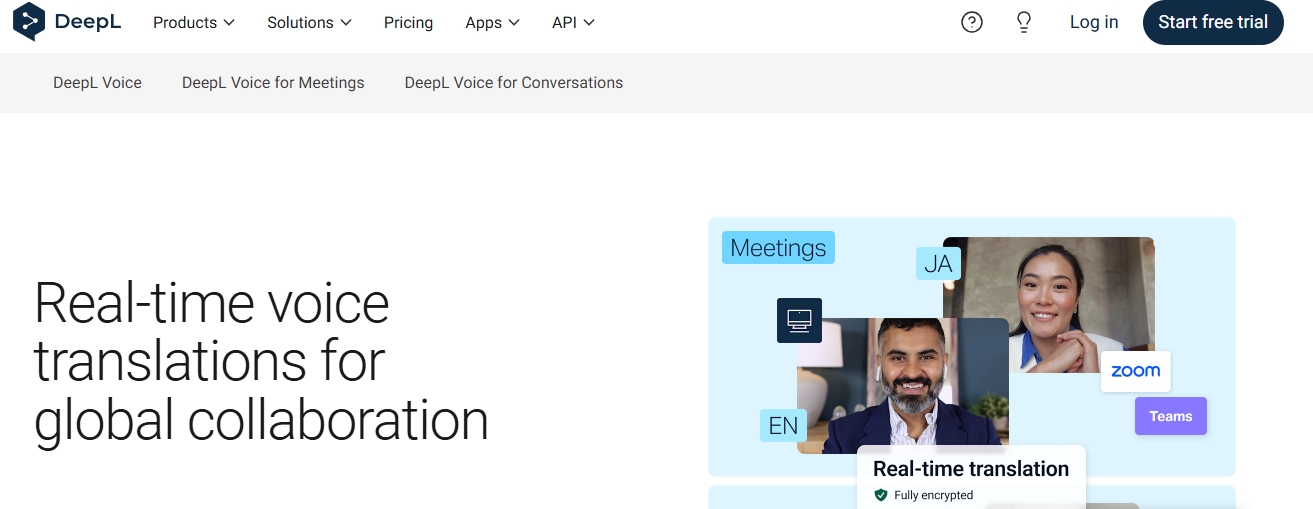
DeepL Voice brings enterprise-grade AI translation tools to business meetings with remarkable fluency. Built on the same neural network as DeepL Translator, this platform enables voice-based real-time communication within Microsoft Teams. It translates speech and generates captions simultaneously, allowing seamless multilingual discussions across continents.
Key Services and Features:
- Real-Time Voice Translation: Converts speech into translated voice output with contextual accuracy.
- Simultaneous Captions: Delivers both audio and textual translations for maximum clarity.
- Multilingual Session Support: Enables multiple speakers to interact in their native languages.
- Deep Integration with Teams: Designed for enterprise-level video meetings and hybrid work models.
As a specialized AI language translation platform, DeepL Voice excels in corporate and enterprise environments that prioritize professionalism, accuracy, and security.
Pros:
- Exceptional translation quality and fluency.
- Built into Microsoft Teams — no third-party dependency.
- Handles nuanced corporate communication effectively.
Cons:
- Limited to 14 supported languages.
- Only works inside Microsoft Teams for now.
Difference Between AI and Traditional Translation
Modern AI translation tools represent a paradigm shift in how languages are processed. Unlike traditional translation which relies on rule-based linguistics and manual human oversight AI models leverage neural networks and deep learning to analyze context, tone, and semantics in real time.
Key Differences Include:
- Speed: AI delivers instant results, while traditional translation takes significantly longer.
- Scalability: Neural machine translation software can handle millions of words daily.
- Context Understanding: AI systems learn from data patterns, adapting tone and phrasing automatically.
- Human Touch: Traditional translators provide cultural depth and creative nuance.
While traditional translation retains a niche for creative and legal projects, AI translation tools have become indispensable for businesses needing fast, consistent, and scalable results across industries.
Benefits of Integrating AI Translation into Business Operations
Integrating AI translation tools into daily workflows has transformed how companies operate across borders. By automating translation at scale, businesses save time, reduce costs, and expand global reach effortlessly.
Core Benefits Include:
- Faster Time-to-Market: Product content can be localized into dozens of languages instantly.
- Improved Accessibility: Enables global teams to collaborate seamlessly.
- Reduced Translation Costs: No longer reliant on full-time translation staff.
- Cross-Platform Integration: Website translation AI solutions 2026 can embed directly into CMS, CRM, and meeting platforms.
According to aurisai, “76% of online shoppers prefer to buy from websites in their native language.” From e-commerce brands expanding to new regions to multinationals conducting multilingual video conferences, AI translation tools streamline communication and strengthen brand consistency globally.
Challenges AI Translation Tools Still Face in 2026
Despite their rapid evolution, AI translation tools still face certain limitations in 2026. While they outperform humans in speed and efficiency, nuanced communication remains challenging.
Key Challenges Include:
- Cultural Sensitivity: AI still struggles to interpret idioms, humor, and regional expressions.
- Context Drift: Complex sentence structures can result in subtle meaning loss.
- Data Security: Cloud-based translation can pose privacy concerns for confidential materials.
- Industry-Specific Accuracy: Specialized fields like law or medicine still require expert review.
As AI-powered localization tools continue to advance, developers are addressing these issues through adaptive learning, customizable glossaries, and ethical AI governance — paving the way for more culturally aware and secure communication systems.
Can AI Translation Replace Human Translators?
The question of whether AI translation tools can replace human translators sparks debate across industries. While AI offers speed, accuracy, and affordability, human translation retains emotional nuance and cultural sensitivity that machines can’t fully replicate.
Where AI excels:
- Bulk text processing for websites, marketing, and customer support.
- Real-time voice translation for global meetings.
- Cost-efficient localization for e-commerce and SaaS platforms.
Where Humans Remain Vital:
- Literary, legal, or culturally complex translations.
- Tone-sensitive branding and marketing content.
- Interpreting sarcasm, idioms, and cultural context.
Ultimately, the future lies in hybrid translation systems, where AI translation tools handle repetitive tasks while human experts refine emotional and creative elements combining the best of both worlds.
Top 5 Best AI Translation Tools 2026 Review
The Top 5 Best AI Translation Tools in 2026 redefine what’s possible in multilingual communication. From event interpretation to content localization and global meetings, these platforms prove that automation and accuracy can coexist.
Here’s our curated review of the top five AI translation tools of 2026 — selected for their accuracy, real-time performance and ability to scale across languages and media types. Whether you’re localizing video content, running multilingual webinars or embedding translation into your global workflow, these platforms set the benchmark.
| Tool | Best For | Key Features | Languages Supported | Pricing Model |
| Wordly AI | Enterprise & events | AI interpretation, captions, glossary | 3,000+ pairs | Quote-based |
| Interprefy | Large conferences | Hybrid AI + human interpretation | 100+ | Quote-based |
| Maestra AI | Creators & educators | Video dubbing, voice cloning, subtitles | 125+ | $39–$159/month |
| Talo | Teams & enterprises | Real-time voice translation, encryption | 60+ | $33–$400/month |
| DeepL Voice | Business meetings | Real-time voice & caption translation | 14 | Quote-based |
Unsure Which AI Translation Tool Fits Your Needs?
Let AWISEE analyze your business goals and provide customized AI translation recommendations — saving you time, money, and complexity.