

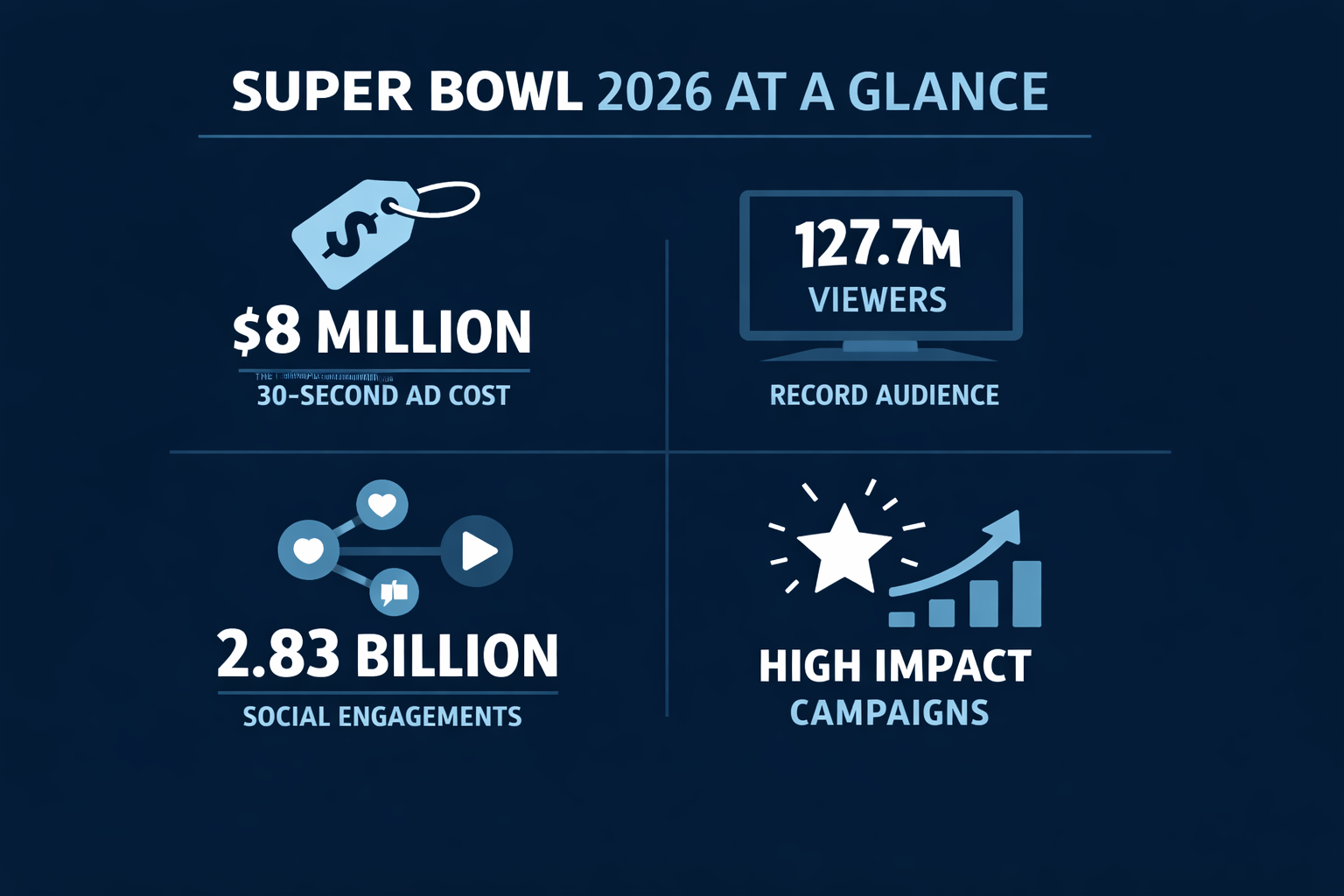
The Super Bowl ads cost is often described as excessive, outdated, or unsustainable. Yet year after year, brands keep paying. This alone suggests the price reflects something deeper than simple advertising inflation. Data collected from emarketer shows that NBC Universal is reportedly charging $8 million for a single 30-second national ad spot during Super Bowl LX.
The Super Bowl remains one of the few moments where marketers can still reach over 100 million people at the same time. That scale matters more now than ever. As digital platforms fragment attention, the value of shared experiences increases.
Super Bowl commercials do not compete in isolation. They dominate culture, conversation, and social feeds for days. This article analyzes Super Bowl advertising statistics to explain why the cost continues to hold in 2026. It looks at pricing trends, engagement data, category shifts, and ROI pressure. The goal is not to glorify the Super Bowl, but to explain it logically. If you want to understand how much a Super Bowl ad costs and why brands still pay, this breakdown provides clarity.
Hire AWISEE and Get Access To The Most Trusted Influencers
AWISEE helps you identify, vet, and collaborate with influencers who speak directly to your audience.
Hire AWISEE to access a fully managed influencer marketing program
Super Bowl Ads Cost in 2026: The Headline Number
The headline figure is simple.
A 30-Second Super Bowl Commercial Price Is About $8 Million
This Super Bowl 30-second ads cost reflects:
- A sharp increase compared to earlier years
- Sustained advertiser demand despite economic uncertainty
- Brands competing for scarcity rather than efficiency
This is the foundation of modern Super Bowl ad pricing.
Why the 30-Second Super Bowl Spot Price Keeps Rising

At first glance, the 30-second Super Bowl spot price feels irrational.
TV viewership is declining.
Digital CPMs are lower.
Targeting is better elsewhere.
So why does the Super Bowl ads cost keep climbing? Because the Super Bowl is not sold like normal TV inventory. Advertisers are paying for three rare advantages at once:
- Massive live reach
- Cultural dominance
- Guaranteed attention
Live Reach Still Anchors The Super Bowl Ads Cost
Amra & Elma noted that Super Bowl LIX (2025) averaged 127.7 million viewers across TV and streaming. That made it the largest average audience for any Super Bowl in history.
Few media events can deliver that level of scale in one moment. That scale directly supports the Super Bowl commercial price.
Peak Moments Drive Extreme Exposure
Viewership during the game was not flat. It spiked.
Peak viewership reached 137.7 million viewers during the second quarter of Super Bowl LIX.
This was the single highest viewership moment in Super Bowl history.
Those spikes matter. They explain why premium placements command higher Super Bowl ad pricing.
Halftime Viewership Alone Justifies Massive Super Bowl Ad Spend
Kendrick Lamar’s halftime show averaged 133.5 million viewers. That is not a niche segment.
That is national saturation.
For advertisers near halftime, exposure rivals the entire game itself. This is one reason the Super Bowl ad spend remains concentrated around premium slots.
Streaming Changed the Game — Without Lowering the Super Bowl Ads Cost
Many assume streaming should reduce the Super Bowl ads cost. The data shows the opposite.
Streaming Added Viewers Instead Of Replacing Them
In 2025, streaming platforms contributed 14.5 million viewers. These included:
- Tubi
- NFL Digital platforms
- Telemundo streaming
Streaming expanded total reach rather than fragmenting it, reinforcing the Super Bowl 30-second ads cost.
Spanish-Language Broadcasts Expanded Total Audience
Spanish-language broadcasts on Fox Deportes and Telemundo drew 1.87 million viewers. This was the first year the Super Bowl aired on both platforms simultaneously.
That expansion matters for advertisers targeting multicultural audiences and supports higher Super Bowl ad pricing.
The Real Super Bowl Ads Cost Is Higher Than $8 Million

The Super Bowl ads cost headline only reflects airtime.
That is misleading.
Most brands spend significantly more.
Typical Super Bowl Ad Spend Includes:
- TV airtime
- Production budgets
- Celebrity fees
- Social media amplification
- Influencer seeding
- Post-game paid distribution
According to Marketing LTB, “Production alone can add $1–5 million on top of the 30-second Super Bowl commercial price.”
This is the real economics behind how much does a Super Bowl ad cost in practice.
How Much Does a Super Bowl Ad Cost Per Second?
Breaking it down helps clarify the Super Bowl ads cost.
Cost per second (2025–2026)
That number sounds extreme.
- $8,000,000 ÷ 30 seconds
- ≈ $266,666 per second
But advertisers are not buying seconds. They are buying simultaneous national attention.
That is why the Super Bowl commercial price still holds.
Super Bowl Ads Cost Over the Last 5 Years (What the Numbers Reveal)
The Super Bowl ads cost did not rise overnight. It followed a very clear curve.
Super Bowl 30-Second Ads Cost History
Data from emarketer and marketing dive shows that:
| Year | Super Bowl | Approx. 30-Second Ad Cost |
| 2022 | LVI | ~$6.5M |
| 2023 | LVII | ~$7.0M |
| 2024 | LVIII | ~$7.0M |
| 2025 | LIX | ~$8.0M |
| 2026 | LX | ~$8.0M |
This table shows something important.
The price jumped. Then it stabilized. That tells us the Super Bowl ads cost reached a new pricing floor, not a temporary spike.
What This Super Bowl Ad Pricing Curve Actually Means
The Super Bowl ads cost did not increase just because of inflation. It increased because:
- Demand consistently exceeded supply
- Brands feared losing cultural relevance
- No alternative media event offers comparable reach
Even as linear TV declines, the Super Bowl becomes more valuable, not less. It concentrates attention in a distracted media world. That concentration supports long-term Super Bowl ad pricing power.
Super Bowl Advertising Statistics That Justify the Cost
The Super Bowl ads cost is no longer justified by TV alone. What happens around the broadcast matters just as much.
Social engagement now defines Super Bowl ad value
In 2025, the Super Bowl generated 2.83 billion social media engagements across:
- X (Twitter)
- YouTube
This shows that modern Super Bowl commercials are not just TV ads. They are social content engines. This dynamic reinforces the Super Bowl ad spend logic.
One Standout Ad Can Dominate The Entire Conversation
Not all Super Bowl commercials perform equally. Some outperform the average by a massive margin.
For example:
- T-Mobile and Starlink’s ad generated 12.6× more engagement than the average Super Bowl LIX ad
This is why brands focus on creative risk-taking despite the high Super Bowl ads cost.
Halftime Engagement Rivals The Ads Themselves
Kendrick Lamar’s halftime show in 2025 generated:
- 80 million social media engagements
- 183,000 social posts
Halftime is now a global media event. Ads positioned near halftime benefit from this momentum, strengthening the Super Bowl commercial price.
Who Still Advertises at These Prices (And Who Doesn’t)
The Super Bowl still attracts dozens of advertisers. But the mix is changing.
How Many Brands Compete During The Super Bowl?
During Super Bowl LIX:
- 63 ads aired
- 57 unique advertisers participated
This level of competition increases pressure on creative quality.
At today’s Super Bowl ads cost, mediocrity is expensive.
Why Auto Brands Are Pulling Back
One of the biggest shifts in Super Bowl advertising is the decline of car ads. Auto brands were once dominant. Now many are stepping back.
Carmakers are prioritizing cheaper, more targeted digital channels instead of paying the full Super Bowl ads cost.
This signals a move toward:
- Performance-driven media
- Longer campaign cycles
- Precision over spectacle
Who Is Filling The Gap?
As auto retreats, other categories step forward:
- Food and beverage brands
- Consumer packaged goods
- Streaming platforms
- Tech and fintech companies
These brands benefit most from:
- Mass awareness
- Emotional storytelling
- Cultural moments
They are more willing to absorb high Super Bowl ad spend.
Do Super Bowl Ads Still Work?
This is the hardest question. And the answer is not simple.
Many Viewers Watch The Super Bowl For The Ads
In 2025:
- 26% of fans said commercials were their favorite part of the Super Bowl
- This was higher than those who preferred the halftime show
The audience expects marketing. That expectation supports the Super Bowl ads cost.
Super Bowl Ads Can Drive Purchases
According to survey data:
- 50% of viewers said they bought something after seeing a Super Bowl ad
That is an unusually strong signal for mass media.
But ROI Efficiency Is Tightening
Despite rising Super Bowl ad pricing:
- ROI efficiency increased only 0.8% year-over-year from 2024 to 2025
This means standing out is harder than ever.
The Super Bowl ads cost now demands better creative, not just bigger budgets.
Creative Trends That Shape Super Bowl Commercial Performance
At this level of Super Bowl ad spend, creative decisions matter more than media buying.
Celebrity Usage Is Becoming More Selective
In 2025:
- 54% of ads featured celebrities
- Down from 77% in 2023
Star power alone no longer guarantees success.
Humor Dominates — But Emotion Lasts Longer
- 85% of ads used humor
- Emotionally driven ads generate stronger long-term recall
This explains why emotional storytelling still outperforms pure comedy.
Pre-Game Ads Often Outperform Game-Day Placements
Many advertisers report:
- Pre-Super Bowl ads perform more efficiently than in-game ads
On game day, attention is split. Before kickoff, audiences are focused.
This insight is critical when planning 2026 Super Bowl commercials.
Super Bowl Ad Pricing vs Digital Alternatives
The Super Bowl ads cost looks extreme in isolation. But brands do not use it alone.
Digital Platforms Extend The Tv Moment
During Super Bowl week:
- 74% of ad spend went to Facebook and Google combined
- Traditional TV represented a smaller share of the total media mix
TV creates the moment.
Digital extends it.
Some Platforms Benefit More Than Others
In 2025:
- YouTube became the third-largest advertising platform during Super Bowl week
- Overtaking TikTok
Video storytelling still matters.
Planning for 2026 Super Bowl Commercials
If the Super Bowl ads cost is $8 million, planning must be precise.
Successful Advertisers Think Beyond 30 Seconds
Smart Super Bowl strategies include:
- Pre-game teasers
- Influencer reactions
- Short-form social cuts
- Post-game paid amplification
- Earned media tracking
The TV ad is only the ignition point.
Measurement Must Be Defined Before Kickoff
Brands that succeed define success early:
- Brand lift
- Search lift
- Social engagement
- Sales impact
- Earned media value
Without this, the Super Bowl becomes an expensive vanity play.
Why the Super Bowl Ads Cost Still Holds in 2026?
On paper, the Super Bowl ads cost looks irrational.
But the numbers explain it.
- Record viewership
- Billions of social engagements
- Cultural dominance
- Scarcity of comparable events
In a fragmented media world, the Super Bowl remains unified. That is why brands keep paying. And that is why the Super Bowl ads cost still holds.
Key Super Bowl Advertising Takeaways (2025–2026)
Before going deeper, it helps to look at the big picture.
The Most Important Numbers Behind The Super Bowl Ads Cost
- A 30-second Super Bowl spot price is about $8 million heading into Super Bowl LX (2026)
- Super Bowl LIX (2025) delivered record average viewership
- Streaming and social engagement now extend Super Bowl commercials far beyond game day
- Advertisers are paying for attention, not impressions
These numbers explain why the Super Bowl ads cost has not collapsed despite industry pressure.
Scale Your Online Store Revenue
Top eCommerce SEO Agencies focus on conversions, not just rankings. Build a search strategy that actually moves the needle for your business.