
When governments restrict social media, the reasoning is rarely simple. Official statements often cite safety, morality, or national security. But enforcement methods tell a deeper story. In 2026, social media ban by country reflects a shift from blunt censorship to structured regulation. Some states block platforms outright. Others impose data laws, registration rules, or local representation requirements.
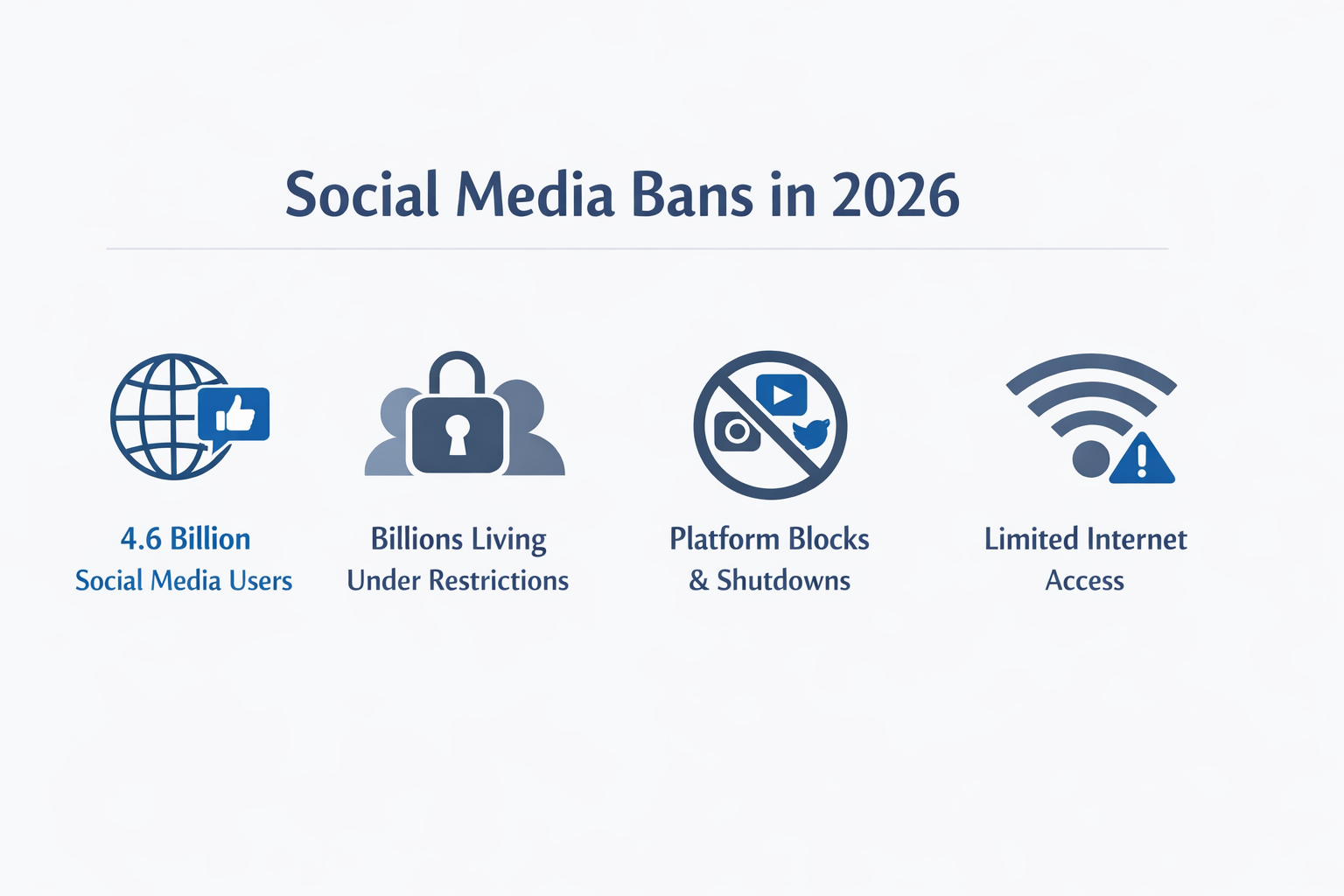
These measures can quietly limit access without public bans. This article examines those strategies in detail. It looks at how countries that ban social media apply pressure differently. It also explains why temporary bans are becoming more common than permanent ones. Using verified reporting, this analysis shows how social media restrictions by country are evolving. The focus is not just on what is blocked, but why and how.
Methodology: How This Article Defines Social Media Ban by Country
Before listing countries that ban social media, definitions matter.
Not every ban looks the same.
What Counts as a Social Media Ban?
In this article, social media ban by country includes:
- Full platform bans (Facebook, Instagram, X, YouTube, TikTok)
- App-level bans (such as TikTok-only bans)
- Nationwide shutdowns during elections or unrest
- Feature restrictions (calls, messaging, video)
- Mandatory compliance rules that lead to blocking
Grow Visibility Where Social Media Is Blocked
In countries where social media platforms are restricted or banned, organic search becomes the primary discovery channel. AWISEE helps brands grow sustainably through advanced SEO and authority-driven link building strategies designed for restricted digital environments.
Countries Banning Social Media: 7 Key Examples Going Into Social Media Ban 2026
Below are the seven most notable countries banning social media, based strictly on the provided sources.
1) China — The Great Firewall Model
China operates the most advanced system of social media censorship by country.
What Is Blocked
- X (Twitter)
- YouTube
- Google services
- TikTok (global version)
Chinese users rely on domestic platforms like WeChat and Douyin. China began blocking major Western platforms in July 2009 following unrest in Xinjiang.
VeePN lists China’s internet freedom score as 10/100 (Not Free). VPN usage to bypass China’s firewall is illegal and punishable.
2) North Korea — Near-Total Digital Isolation
North Korea represents the most extreme social media ban by country.
What Is Blocked
- All global social media platforms
- Most access to the global internet
Only elites, scientists, and foreign visitors receive limited access.
The public uses a government-controlled intranet.
VeePN previously recorded North Korea’s internet freedom score as 3/100.
3) Iran — Long-Term Platform Blocking
Iran has enforced social media bans worldwide for over a decade.
What Is Blocked
- X (Twitter)
- YouTube
- Instagram (banned after 2022 protests)
- Messaging apps frequently disrupted
Iran first restricted platforms after the 2009 election unrest.
VeePN assigns Iran an internet freedom score of 16/100 (Not Free).
4) India — Selective Social Media Ban (TikTok)
India does not block all platforms. But its TikTok ban reshaped social media ban 2026 discussions.
What Is Blocked
- TikTok
- 58 additional mobile apps (since June 2020)
The government cited national security concerns.
VeePN lists India’s internet freedom score as 49/100 (Partly Free).
5) Turkmenistan — Heavy Monitoring and Broad Social Media Blocks
Turkmenistan is one of the most restrictive social media blocked countries in the world.
The government tightly controls internet access. Most global platforms are either blocked or heavily filtered.
What Is Blocked
- X (Twitter)
- Russian social networks
Citizens rely on a government-run intranet, not the open internet.
VeePN lists Turkmenistan’s internet freedom score as 2/100 (Not Free). This places the country among the most extreme examples of social media censorship by country.
6) Uganda — Election-Driven Social Media Ban by Country
Uganda illustrates how social media bans worldwide are often tied to elections.
The country does not permanently block platforms. Instead, access disappears when political tension rises.
What Is Blocked
- Other platforms during election periods
Uganda has repeatedly restricted social media during national elections. Officials framed these actions as necessary for security and stability.
VeePN assigns Uganda an internet freedom score of 49/100 (Partly Free). Uganda once introduced a daily social media tax to “curb online gossip.”
- Users were charged 200 Ugandan shillings per day
- The policy collapsed after public backlash
This case shows that even failed controls reveal long-term intent.
7) Nepal — Administrative Social Media Ban 2026 Pattern
Nepal represents a new form of social media ban by country. In 2025, the government announced a ban on 26 major social media platforms.
What Triggered the Ban
- Platforms allegedly failed to register with authorities
- The government cited regulatory non-compliance
Times of India lists affected platforms including:
- YouTube
- X (Twitter)
This matters because the ban was not ideological. It was administrative. This model may become more common in social media ban 2026 policies.
Why Governments Restrict Social Media Platforms
Governments rarely say they are limiting free speech. Instead, they frame social media censorship by country as protection.
Across both sources, the same patterns appear repeatedly.
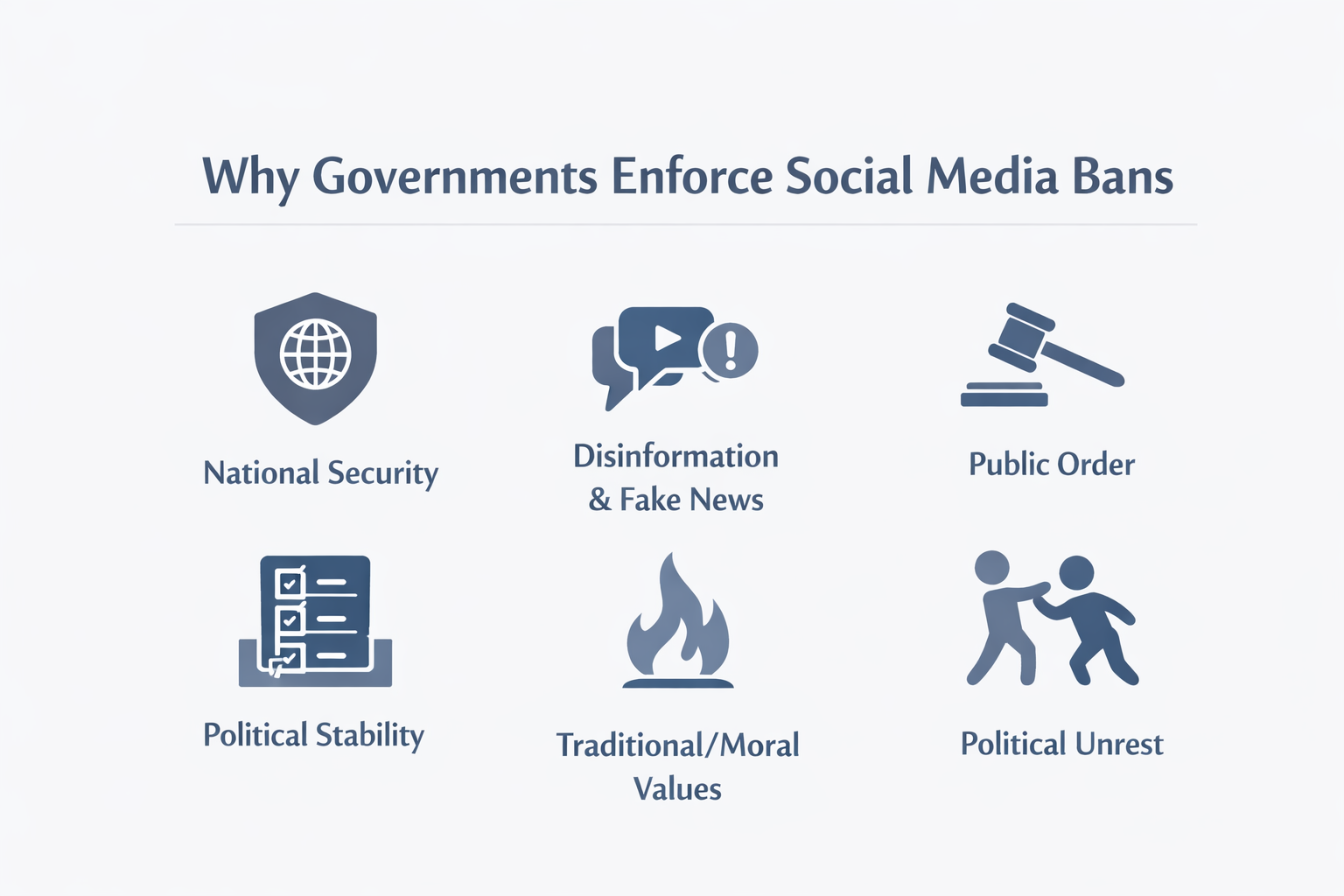
The Most Common Justifications
Governments often cite:
- National security
- Political stability
- Public order
- Traditional or moral values
- Disinformation and fake news
VeePN explains that political unrest and narrative control are often the real drivers behind global social media bans, even when public safety is the official explanation.
Times of India reinforces this by showing how social media restrictions by country increase during:
- Elections
- Protests
- Terror attacks
- Regime changes
Social Media Restrictions by Country: How Bans Are Enforced
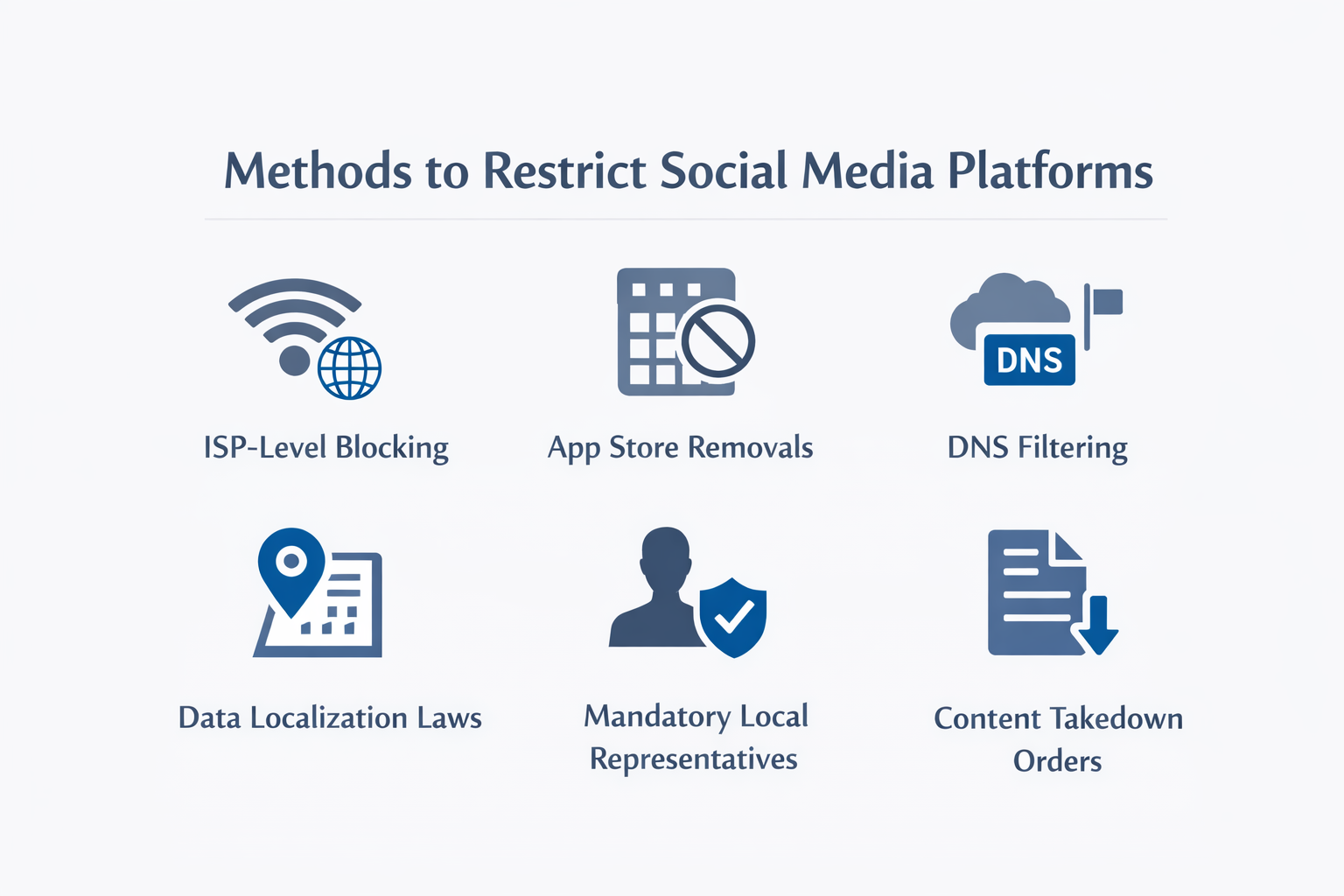
A social media ban is rarely a single action. Most governments apply layered controls.
Common Enforcement Methods
- ISP-level blocking
- App store removals
- DNS filtering
- Data localization laws
- Mandatory local representatives
- Content takedown orders
Some social media blocked countries allow access but punish users. Others block platforms technically but tolerate quiet workarounds.
Social Media Restrictions by Country: The “Restriction Zone” Model
Not all countries banning social media use full bans. Some apply pressure instead. These countries operate in a restriction zone.
Turkey — Temporary Blocks and Compliance Pressure
Turkey frequently restricts platforms during unrest.
How Restrictions Work
- Temporary platform bans
- Internet throttling
- Content takedown orders
Platforms blocked at different times include:
- X (Twitter)
- YouTube
VeePN lists Turkey’s internet freedom score as 34/100 (Not Free).
Myanmar — Coup-Driven Social Media Suppression
Myanmar’s social media restrictions by country intensified after the 2021 military coup.
What Happened
- Facebook blocked
- Messaging apps restricted
- VPN access targeted
This pattern appears across many countries that ban social media during instability.
Afghanistan — Monitoring and Regional Internet Shutdowns
Afghanistan has expanded restrictions since 2021.
What Is Reported
- Monitoring of social media platforms
- Internet shutdowns in multiple provinces
- Justifications based on morality and religion
Times of India reports shutdowns of fiber and Wi-Fi access in some regions.
Russia — Feature Limits Instead of Full Platform Bans
Russia uses selective restriction instead of full bans.
How Restrictions Work
- Voice and video call limitations
- Feature-level controls
- Local office requirements
Global Social Media Ban By Country: What These Cases Reveal for 2026
When viewed together, patterns emerge.
Trend 1: National Security Is the Default Explanation
Almost every social media ban by country uses it.
Trend 2: Platform Control Replaces Platform Bans
Compliance rules are replacing outright blocks.
Trend 3: Elections Trigger Social Media Bans Worldwide
Uganda, Turkey, and Myanmar show this clearly.
Trend 4: Domestic Platforms Replace Global Ones
China remains the clearest example.
Win Traffic in Countries That Ban Social Media
AWISEE helps brands capture demand through localized SEO and compliant link building in countries where social platforms are unavailable or unreliable.