

Small business statistics Europe provide a clearer picture of economic reality than headline GDP figures ever could. Behind every employment number and turnover chart sits a network of small firms doing daily operational work. These businesses are not experimental ventures. They are long-established contributors to Europe’s stability. From retail and construction to services and manufacturing, SMEs operate across every major sector.
While large corporations dominate headlines, they represent only a fraction of businesses operating across the European Union. The majority of economic activity happens at a much smaller scale. Millions of micro and small enterprises operate in cities, towns, and rural areas every day.
This article examines small business statistics Europe using verified data only. Each figure is grounded in official European reporting. By understanding SME statistics Europe, readers can see how economic value is created and distributed. In 2025, ignoring SME data means misunderstanding Europe’s economy.
Small Business Statistics Europe: How Many Enterprises Exist in the EU?
Small businesses dominate the European Union by sheer scale. And the difference is not marginal. According to Eurostat, in 2022, the EU recorded 32.3 million enterprises in total. Out of these, 99% were micro and small enterprises, meaning businesses employing up to 49 people. This single statistic defines the entire structure of the European economy.
Total number of enterprises in the EU (2022)
- Total enterprises: 32.3 million
- Micro + small enterprises: 99%
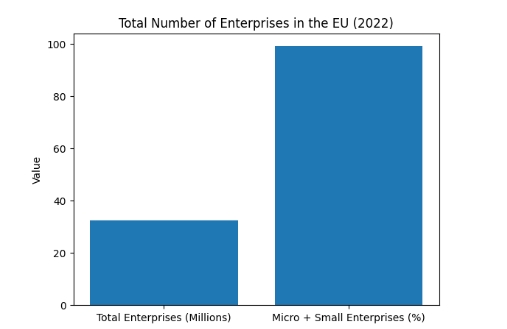
These small business statistics Europe show that large firms are the exception, not the rule. Europe Data shows that medium-sized enterprises account for just 0.8% of all businesses, while large enterprises represent only 0.2%. In practical terms, that means 998 out of every 1,000 businesses in Europe are SMEs. This distribution explains why SMEs in Europe shape entrepreneurship, employment patterns, and local economies more than any other business category.
Turn SME Data Into Measurable Growth
AWISEE helps small and medium businesses convert market presence into online demand through SEO, link building, and targeted influencer marketing strategies.
Employment Concentration: Where SME Data Europe Tells the Real Story
Employment is where SME data Europe becomes even more revealing. In 2022, Employment in micro & small enterprises (2022) is as follows:
- Total EU enterprise employment: 160 million
- Micro & small employment: 77.5 million (48%)
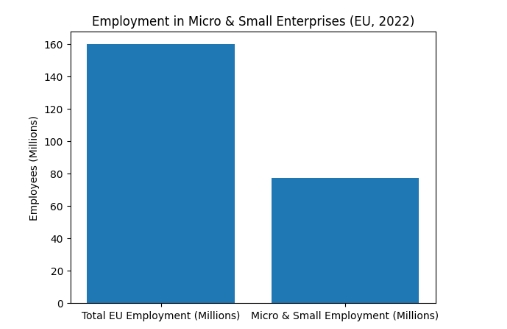
Medium-sized enterprises employed 15% of the workforce, while large enterprises employed 37%. This confirms a long-standing pattern in SME statistics Europe: small firms are labor-intensive, while large firms concentrate scale. The same structure appeared in 2021. That year, as per EUbusiness, 75.8 million people worked in micro and small enterprises, accounting for roughly half of EU employment.
SME employment (2021)
- Micro & small employment: 75.8 million
- Share of total employment: ~50%
This stability confirms that SME trends Europe are structural, not temporary.
Turnover and Small Business Growth EU: Where Revenue Concentrates
Employment tells one story. Turnover tells another.
SME turnover in the EU (2022):
- SME turnover: €11.9 trillion
- Share of total turnover: 31%
- Total turnover: €38.3 trillion
Medium-sized enterprises contributed 18%, while large enterprises generated 51% of total turnover. Even though large firms represent only 0.2% of businesses, they capture more than half of all revenue. This imbalance explains why small business growth EU depends heavily on productivity gains rather than scale alone.
SME Statistics Europe by Sector: Industry, Trade, Construction, Services
Sector data provides crucial context for European SME market analysis. Industry sector contribution (2022) is as follows:
- Turnover: €13.6 trillion (35%)
- Employment: 33.4 million (21%)
- Enterprise share: 8%
The trade sector employed 29.8 million people, operated 5.8 million enterprises, and generated €11.2 trillion, or 29% of turnover. Construction, meanwhile, represented 12% of enterprises but generated only 6% of turnover (€2.1 trillion), employing 13.8 million people.
In 2021, other services dominated enterprise count, representing 61% of all firms, employing 80.2 million people, and generating €9.8 trillion. Together, these figures define the operational reality of SMEs in Europe.
Value Added: A Deeper Look at Small Business Statistics Europe
Value added shows real economic contribution.
In 2021, micro and small enterprises generated €3.3 trillion in value added, representing 35% of total EU value added. Medium enterprises contributed 17%, while large firms accounted for 48%. This confirms the central role of SMEs in Europe’s real economic output.
Labor Costs and SME Data Europe: Who Pays More Per Employee?
Across the EU, the average employee benefits expense stood at €41,340.
High-cost sectors included:
- Financial and insurance: €77,500
- Electricity and gas: €68,100
- Information and communication: €67,530
Lower-cost sectors included:
- Accommodation and food services: €20,630
- Education: €28,730
- Administrative support: €29,940
Employee costs also rise sharply with firm size. In manufacturing:
- 0–9 employees: €28,510
- 50–249 employees: €40,820
- 250+ employees: €59,460
These patterns shape wage inequality across the European SME market.
Small Business Europe 2025: How Entrepreneurs Actually Work
Finally, small business Europe 2025 is also about human effort. Entrepreneurs work 41+ hours per week, compared to 36 hours for employees. In some countries, self-employed workers exceed 48 hours weekly.
Lunch breaks and holidays are often sacrificed. In the UK, 43% of small business owners rarely take lunch breaks. Holiday sacrifices remain common, especially among female entrepreneurs in Italy and Ireland. These figures show that behind small business statistics Europe, there is sustained personal effort.
Key Takeaways From Small Business Statistics Europe
As per AWISEE, “It’s no secret that e-commerce in Europe is surging. From Berlin to Barcelona, online shopping is reshaping how Europeans engage with products, brands, and technology.” Here are some key takeaways from the SMEs statistics in Europe:
- SMEs represent 99% of EU enterprises
- They employ nearly half of the workforce
- They generate trillions in turnover and value added
- Sector structure shapes productivity
- Labor costs rise with size and specialization
- Entrepreneurs work longer and rest less
This is why European small business statistics remain essential reading in 2025.
Help Your SME Get Found in Search
Most European customers start with search. AWISEE helps SMEs rank for high-intent keywords using technical SEO and authority-building backlinks designed for competitive European markets.