

Millennials social media statistics continue to explain how modern digital behavior actually works in 2026. Millennials are no longer the youngest users online, yet they remain one of the most influential demographics across every major social platform. Positioned between Gen Z creativity and Gen X purchasing power, Millennials control household budgets, influence family buying decisions, and shape long-term brand loyalty.
These millennials social media statistics show that this generation does not treat social platforms as entertainment alone. Millennials use social media for shopping, education, news consumption, customer service, and peer recommendations. Understanding millennials social media usage provides insight into how online behavior has matured over the past decade. It also explains why brands that rely only on Gen Z tactics struggle to convert Millennial audiences.
This article breaks down verified millennials social media data sourced from trusted research providers. Each statistic reflects real usage patterns, buying behavior, and engagement habits. Together, these insights explain how social media usage by millennials continues to drive digital commerce, brand trust, and content strategy in 2026.
Market to Millennials Where Decisions Actually Happen
Millennials use social media for discovery, research, and purchasing—not just entertainment. AWISEE helps brands design social media marketing strategies that align with Millennial habits, platform preferences, and trust signals to drive real engagement and conversions.
Millennials Social Media Statistics: 2026 Snapshot
According to AWISEE, “Millennials are the people who are in their late 20s to early 40s—building families, leading companies, shaping policies—and driving the global economy. ” Before exploring deeper millennials online behavior statistics, it helps to understand the high-level picture. Data taken from Cropink and Content Science reviews reveal that:
- 86% of Millennials actively use social media
- Average Millennial manages 8.4 social media accounts
- Millennials spend approximately 2 hours and 25 minutes per day on social platforms
- 56% have purchased a product because of an influencer
- 65% buy based on a friend’s social media recommendation
- Facebook, YouTube, and Instagram dominate daily usage
- Social media functions as a primary news source for Millennials
These numbers confirm that Millennials are not disengaging from social platforms. Instead, millennials digital behavior data shows they are becoming more intentional and selective users.
Millennials Social Media Usage: Time Spent Online
Daily usage patterns reveal important differences across generations. According to millennials social media statistics, Millennials spend an average of 2 hours and 25 minutes per day on social platforms. This places them below Gen Z, who average roughly three hours, but well above Baby Boomers, who average about one hour daily.
These millennials social media insights show that Millennials value efficiency. They are present online, but they do not scroll endlessly. Their attention is purposeful.
Average Daily Social Media Usage by Generation
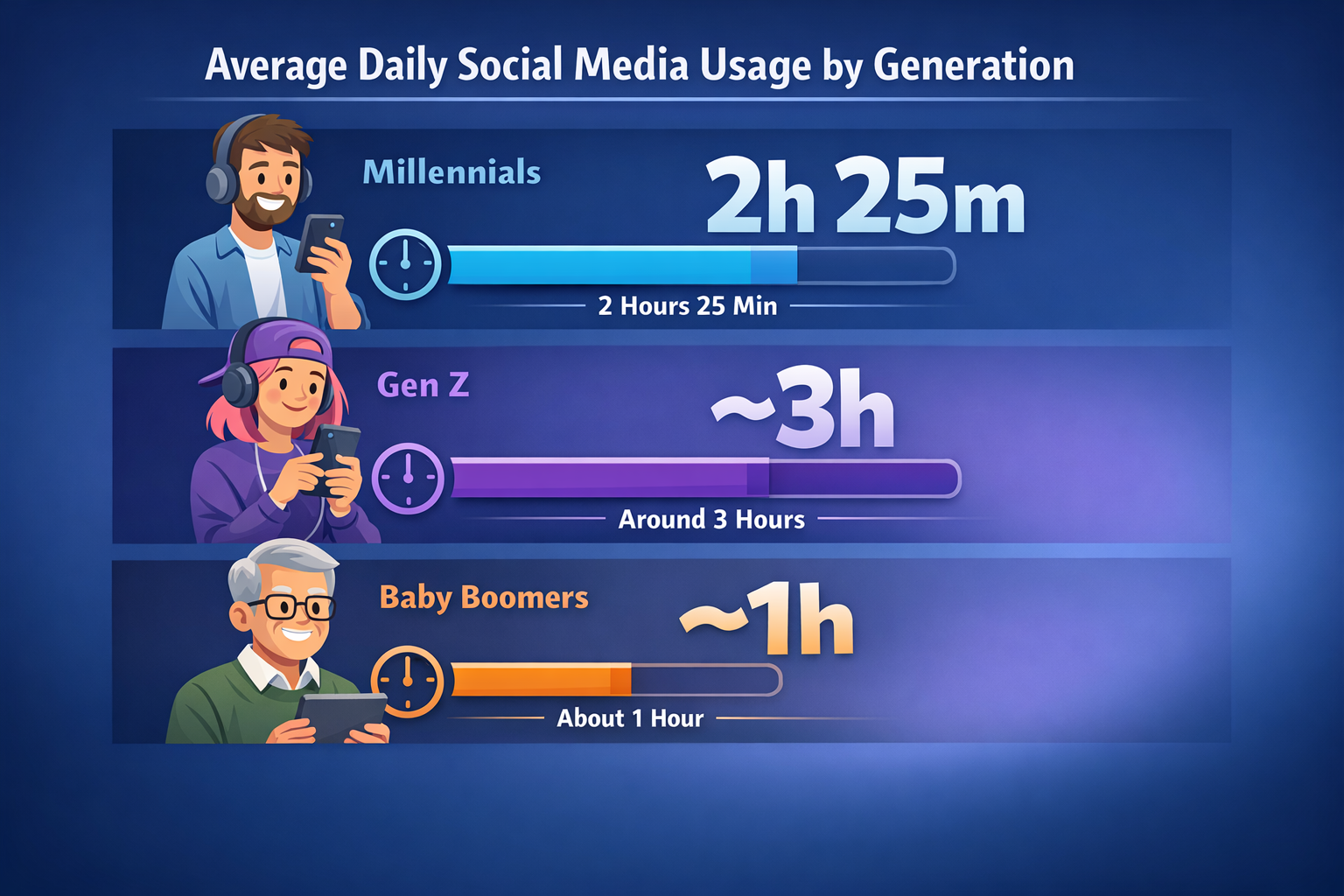
- Millennials: 2h 25m
- Gen Z: ~3h
- Baby Boomers: ~1h
Weekly Time Spent Online (Distribution)

Daily averages only tell part of the story. Weekly millennials social media usage patterns show wide variation:
- 20% spend more than 20 hours per week
- 12% spend 15–20 hours
- 16% spend 10–15 hours
- 23% spend 5–10 hours
- 18% spend under 5 hours
- Only 8% spend less than 5 hours
These millennials online behavior statistics confirm that the generation is not uniform. Some are power users. Others engage selectively based on need and relevance.
Smartphone-First, Always Connected
Long-term millennials digital behavior data shows that mobile remains central to how Millennials access the internet:
- Nearly 100% of Millennials use the internet
- 19% rely exclusively on smartphones
- Over 90% own a smartphone
- 86% use social media regularly
- 95% browse the internet while using another screen
For many Millennials, the phone is the internet. This behavior explains why speed, usability, and frictionless design remain critical for engagement and conversion.
Platform Landscape: Where Millennials Spend Their Time
Despite platform fragmentation, millennials social media statistics from Sprout Social show usage remains concentrated:
- 85% use Facebook
- 80% use YouTube
- 74% use Instagram
Each platform serves a distinct role. Facebook supports community and customer service. YouTube dominates long-form video and education. Instagram blends identity, lifestyle, and discovery.
Platform Engagement Patterns
Millennial social media stats 2026 show that usage behavior differs by platform:
- Facebook: news, groups, brand communication
- YouTube: tutorials, education, long-form entertainment
- Instagram: short-form video, shopping inspiration, visual discovery
This confirms that cross-posting identical content does not work. Effective strategies align format with platform behavior.
Short-Form vs Long-Form Content Preferences
Millennials consume both formats, but context defines performance:
- Instagram favors short-form video
- YouTube favors long-form video
- Facebook still supports text-based brand content
These millennials social media trends 2026 highlight the generation’s balanced consumption style, positioned between Gen Z and older demographics.
Millennials Social Media Data on Content Engagement
Millennials engage with content that delivers value. High-performing formats include:
- Educational posts
- How-to videos
- Relatable entertainment
- User-generated content
According to millennials social media statistics from Cropink, 90% prefer authentic content over polished advertising. This explains the sustained effectiveness of creator-led marketing.
Authenticity and Interactive Content
Survey-based millennials social media insights reveal that tone determines success:
- 75% find traditional ads annoying
- Millennials remain 25% more likely than older generations to buy from social ads when tone feels authentic
Interactive formats such as polls, quizzes, and comment-driven posts increase engagement and community trust.
Social Commerce and Buying Behavior
Influencers play a role, but millennials social media statistics show relatability matters more than reach:
- 56% have purchased based on influencer recommendations
Peer influence is even stronger:
- 65% purchase based on a friend’s recommendation
These patterns confirm that millennials social media usage collapses the traditional funnel. Discovery, research, and purchase often happen in a single session.
Social Media as a News Source
Millennials online behavior statistics show social platforms function as primary news channels:
- 88% use Facebook for news
- 83% use YouTube
- 50% rely on Instagram
Millennials engage with news visually and socially, preferring context, commentary, and peer discussion.
Brand Interaction and Customer Service
Millennials social media data shows strong expectations around responsiveness:
- 60% use social media for customer service
- 99% would refer a business if they felt connected on social platforms
Brands that fail to respond risk churn. Brands that engage build advocacy.
Millennials Social Media Trends 2026
Millennial social media stats 2026 highlight several shifts:
- 31% plan to increase social media usage
- Growing interest in Reddit, Bluesky, Threads, Mastodon
- Increased adoption of Patreon and Substack
Millennials favor depth, relevance, and consistency over virality.
Mental Health and Emotional Signals
Despite concerns, millennials social media statistics show balanced sentiment:
- 68% say social media positively impacts mental health
- 61% say it improves their social life
Millennials do not want less social media. They want better experiences.
These millennials social media statistics point to intentional usage patterns. Millennials reward relevance, speed, emotional intelligence, and authenticity. They ignore noise. They support value.
Practical application requires aligning content, platforms, and tone with real millennials digital behavior data.\
Social Media Marketing Designed Specifically for Millennials
Millennials respond differently than Gen Z. AWISEE helps brands avoid mismatched strategies by crafting social media marketing that reflects Millennial priorities like trust, usefulness, and peer influence.
Align your social media strategy with Millennials through AWISEE