

Japan’s deep-rooted respect for nature — from cherry blossom strolls to hiking in the Japanese Alps — continues to shape its booming outdoor lifestyle market. In 2025, the Japanese outdoor market is setting global benchmarks in both product innovation and cultural lifestyle integration. But something has shifted. What was once a seasonal escape has turned into a full-blown lifestyle.
In fact, the Japanese outdoor market 2025 has become one of the most talked-about in the global industry. Blending heritage with high-performance gear, this market now sits at the intersection of design, utility, and culture — and it’s expanding faster than anyone expected.
Overview of the Japanese Outdoor Market 2025
So, how big is the outdoor scene in Japan these days? As interest continues to soar, the Japanese outdoor market 2025 represents more than a trend — it’s a full-scale economic driver and cultural movement. Japan’s outdoor equipment market is projected to grow to ¥500 billion ($3.5 billion USD) by the end of 2025.
across categories like high-performance apparel, minimalist camping gear, glamping resorts, and mountain tourism. And it’s not just hardcore adventurers fueling it. Office workers, students, and even retirees are joining in.
Local brands such as Snow Peak, Montbell, and Nanga dominate, offering a unique mix of functionality and aesthetic appeal. At the same time, global players like The North Face, Columbia, and Patagonia are carving out their own niches, often collaborating with local designers to appeal to Japanese tastes.
Popular destinations such as Hokkaido, Nagano, and Yamanashi continue to attract campers and hikers alike. And in urban Tokyo, rooftop setups and balcony-friendly gear are feeding a new form of nature integration — part of what defines the outdoor lifestyle trends in Japan.
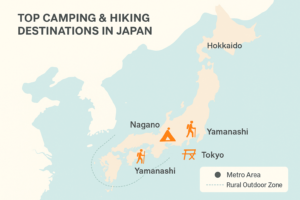
Key Camping and Hiking Regions in Japan
Break Into Japan’s Outdoor Scene with Influencer Precision
Want to introduce your outdoor gear brand to Japanese consumers? AWISEE offers influencer marketing campaigns crafted to connect with hikers, campers, and minimalists. We build data-backed custom ads tailored to Japan’s outdoor shopping behavior. Whether you’re selling tents or techwear, our experts ensure your ads land on the right screens — with maximum ROI.
What’s Driving Growth in Japan’s Outdoor Industry?
This growth isn’t just numbers — it’s cultural.
Post-pandemic shifts have reshaped what leisure and wellness look like. People are spending more weekends outside, hiking or camping, not just for fun but for mental clarity. These habits stuck and evolved into a lifestyle.
Wellness-driven consumers are prioritizing quality time in nature over entertainment complexes. Meanwhile, eco-consciousness has taken hold. There’s a growing rejection of disposable, fast-consumption goods in favor of durable, repairable outdoor gear.
Interestingly, this isn’t being led by older generations — it’s Millennials and Gen Z who are pushing this shift the hardest. They view nature as an extension of their lifestyle — a space to work, recharge, or create. In short, they’re redefining how the Japanese outdoor market 2025 is evolving from seasonal escape to everyday culture.

Who Is Driving the Outdoor Boom in Japan (2025)
For lifestyle brands, especially in beauty, Japan’s TikTok Shop is emerging as a powerful channel — aligning seamlessly with the outdoor and wellness content trends dominating social media.
The Rise of Outdoor Lifestyle Trends in Japan
Functionality and fashion are merging.
From sleek techwear jackets to all-weather sandals, outdoor gear is now as much about city life as it is about the backcountry. Outdoor lifestyle trends in Japan have birthed a new design aesthetic that prioritizes minimalism, modularity, and multi-use.

Urban vs Nature – Japan’s Evolving Outdoor Lifestyle
What’s truly surprising is the spread of work-from-campsite culture. People are packing up solar chargers, Wi-Fi routers, and foldable desks to conduct meetings in the forest. It’s not a gimmick — it’s become a preferred way of blending productivity with peace.
This crossover from the trail to the home (and back) is shaping product design. Coffee grinders, lanterns, and cookware now need to look good on a hardwood shelf and perform flawlessly on a rocky trail. And brands are rising to meet the challenge — proving that the Japanese outdoor market 2025 is as much about lifestyle integration as it is about gear performance.
The Camping Boom in Japan
If there’s one trend that perfectly encapsulates this outdoor revolution, it’s camping.
The growth of camping and hiking in Japan is evident across every metric — from skyrocketing tent sales and gear rental surges to increased campground construction and government-backed initiatives.
Younger couples are embracing RV life, while solo campers — often inspired by YouTube and Instagram — are heading out on peaceful weekend retreats. Glamping has become a luxury trend, and even traditional campsites now offer digital booking systems and beginner-friendly rental kits.
There’s also a social movement forming around solo camping, especially among women and younger men. It’s a form of solitude that feels restorative — not lonely — and it’s changing how people interact with nature.
Retail and E-Commerce Shifts in Japan’s Outdoor Market
The retail landscape for outdoor goods in Japan has evolved dramatically since 2020.
Niche outdoor stores in Tokyo and Osaka are no longer just retail spaces — they’re immersive experiences. From tent-testing areas to forest-inspired showrooms, brands are curating environments that let shoppers visualize their next nature escape before even making a purchase.
Meanwhile, the surge of direct-to-consumer (D2C) brands has brought greater flexibility. These newcomers offer personalized gear kits, on-demand product support, and stylish subscription boxes, all built with a focus on digital-native engagement.
While platforms like Rakuten and Amazon Japan remain dominant, specialist e-commerce hubs — such as Yamatomichi or Alpen Outdoors — have carved out strong followings. Still, it’s not a complete digital takeover. The Japanese consumer expects omnichannel ease: order online, try in-store, return via app.
Surprisingly, physical retail is staging a comeback — especially those offering in-store “camp zones” and interactive displays. Shoppers want to experience before they invest, and brands are responding with creativity.
How Social Media Shapes Outdoor Lifestyle Trends in Japan
Social media is a driving force behind outdoor lifestyle trends in Japan.
Platforms like YouTube are brimming with cinematic solo camping content. These videos — often quiet, meditative, and focused on nature rituals — have become a digital escape for millions. The creators behind them? Cultural tastemakers in their own right.
On Instagram, aesthetics reign. Perfectly arranged flat-lay gear, coordinated tents and outfits, and serene lakeside coffee brews dominate the feed. It’s not just camping — it’s an art form.
And TikTok? It’s where the fast-moving gear trends live. From tent setup hacks to pocket-sized cookware reviews, this platform drives micro-purchases that often lead to sell-out situations.
Influencers aren’t just promoting — they’re co-creating. Brands now collaborate with local voices to launch limited editions and even develop exclusive best-selling outdoor products in Japan’s market that merge function with fashion.
Sustainability and Ethics in the Japanese Outdoor Market
Sustainability isn’t a trend in Japan — it’s a standard.
Modern outdoor consumers here expect eco-conscious materials, carbon-neutral packaging, and gear that lasts. Brands that showcase traceability and invest in regenerative practices are seeing stronger loyalty than ever.
What’s uniquely Japanese is the deeply rooted repair culture. Damaged gear isn’t discarded — it’s restored. Some even embrace patchwork aesthetics, proudly displaying a repaired jacket as a badge of experience.
Equally powerful is the rise of gear-rental platforms and secondhand markets. From rotating tents to borrowing ultralight sleeping bags, the shift from ownership to shared-use models is helping reduce waste — and build community.
Key Outdoor Brands and Market Players in Japan
The Japanese outdoor market 2025 continues to be shaped by its most iconic homegrown players.
Snow Peak has transformed from gear maker to full lifestyle brand, complete with apparel lines, architecture projects, and its own outdoor-themed cafes. Montbell retains its loyal following through technical reliability at accessible price points, while Nanga is earning global recognition for its Japanese-crafted down products.
International labels like Patagonia, The North Face, and Columbia remain strong contenders. But they succeed in Japan not by duplicating global formulas — rather, by localizing design, partnering with regional creators, and respecting Japanese outdoor culture.
Meanwhile, mainstream retailers like Uniqlo are making lightweight, camping-ready gear that appeals to casual explorers. Even drugstores have joined in, offering compact essentials like rain ponchos and headlamps — a surprising reflection of how Japan’s outdoor market is evolving in 2025.
Best-Selling Outdoor Products in Japan’s Market (2025)
The chart below showcases the top-selling outdoor gear in Japan’s 2025 market — a visual snapshot of evolving consumer preferences. Tents lead the chart with the highest market share at just over 25%, indicating strong consumer demand, likely driven by Japan’s growing interest in camping and nature retreats.
Camping Chairs and Lanterns follow, holding approximately 20% and 18% of the market respectively, showing that comfort and lighting are key priorities for outdoor enthusiasts.
Cooking Gear ranks next with a 15% share, highlighting the importance of meal preparation in outdoor activities. Lastly, Hiking Backpacks hold around 12%, reflecting the steady popularity of hiking and mobility-based outdoor recreation.

Japan’s outdoor consumers are active across retail channels — and so is AWISEE. Our full-service media planning and influencer strategies target both digital and offline spaces. Our partnerships turn views into conversions. Learn more at AWISEE.
Future Outlook: How Japan’s Outdoor Market Is Evolving In 2025
Looking ahead, the Japanese outdoor market 2025 stands at an exciting crossroads.
Innovation is steering the next chapter — with smart gear like weather-reactive jackets, AI-guided campsite planning tools, and solar-integrated tents entering the scene. The boundary between tech and terrain is quickly dissolving.
Hybrid products — such as multi-functional chairs, convertible backpacks, and Bluetooth lantern-speakers — are becoming staples, reflecting modern demands for compact, stylish versatility.
Most intriguing of all? The potential for Japan’s outdoor lifestyle to become a global export. Just as sushi, Zen gardens, and minimalist interiors gained worldwide admiration, Japan’s elegant, tranquil, and intentional outdoor culture may soon inspire a new wave of international enthusiasts.

Timeline – Evolution of Japan’s Outdoor Market (2019–2025)
In short, Japan isn’t just following the global outdoor movement — it’s starting to lead it.