

How to Build a Retail Influencer Strategy That Converts?

Not every influencer campaign delivers results—because strategy is what makes the difference.
Jasmine Khachatryan, a marketing writer and influencer specialist, recommends starting with a clear goal. Are you trying to:
- Boost foot traffic to stores?
- Increase brand awareness?
- Drive direct purchases?
Once that’s clear, the next step is to choose the right influencer.
Here’s what Jasmine suggests:
Define the influencer persona: Who speaks your brand’s language? Who shares your audience?
Don’t focus only on follower count—micro-influencers with loyal, engaged audiences often outperform bigger names.
Check alignment: Do their values and aesthetic match your product? Are they already talking about your category?
She also emphasized that micro and nano influencers can offer better ROI. Their audiences trust them more. Their recommendations feel genuine. And they’re more cost-effective, which means you can work with more of them at once. That’s why influencer marketing retail thrives on micro and nano partnerships that feel authentic and localized.
Tactics to Maximize Influencer Marketing Retail Campaigns
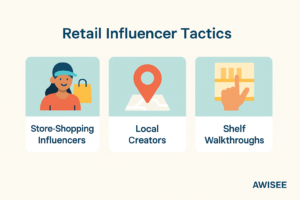
Let’s get practical.
These are small but powerful tactics that work especially well for retail brand influencer marketing:
- Choose creators who shop at the store already
If your product is in Target, work with creators who already post Target content. It feels more natural—and authentic. - Think local
If you’re launching regionally, use influencers based in that area. They’ll connect better with local audiences and mention relevant store locations. - Make them show the shelf
Ask influencers to walk through the store and highlight exactly where the product is on the shelf and what it’s near. That kind of detail removes friction and drives action.
Drive Retail Sales with Influencers Through Shoppable Content and UGC

Influencer marketing retail campaigns that leverage UGC tend to convert better because they feel more relatable and actionable. The most effective content blends UGC with influencer promotion—that’s the sweet spot.
Milan Kovacevic pointed out the growing use of tools like Firework’s shoppable video, which lets users buy directly from the video content. “It creates a seamless path from engagement to purchase,” he explained.
And Jasmine Khachatryan adds that influencer-created content doesn’t just sell—it sticks.
Here’s how to make the most of it:
- Use promo codes or tagged links
They create urgency and help track conversions. - Repurpose their content
Use influencer videos in:- Your paid ads
- Store displays
- QR codes near the product shelf
- Social media retargeting
- Encourage real customers to share their experiences too
Reward UGC. It builds trust and creates a community around your product.
Effective Influencer Strategies for Retail Businesses
Want to know what really works? Let’s talk about strategies that drive results—especially for in-store sales.
Influencer marketing retail efforts are most effective when launched during the early stage of a product’s shelf life. According to Priya Nain, “The first 4–8 weeks after your retail launch are crucial.” Retailers like Target and Walmart are watching sales velocity closely. If your product doesn’t move fast enough, they might not keep you on the shelves. No pressure, right?
This is exactly where a solid retail influencer strategy becomes essential.
Here are three methods Priya recommends to boost visibility and retail performance:
- Create dedicated retail hashtags
Examples like #PoppiWalmart or #MagicSpoonTarget work well. Influencers and users posting under these hashtags generate discoverability and retailer interest. - Show exact shelf placement
Make sure your product stands out—don’t let it disappear on the shelf. Priya suggests having influencers record their in-store journey and guide followers to your product’s location. Even simple notes like “next to the Modern Soda section” help. - Use influencer repetition for brand recall
Repeated exposure from multiple influencers builds brand familiarity and trust. Soon, it becomes, “Hey, I saw that on TikTok!” to “I picked it up at Walmart.”
Retail Influencer Strategy

Shelf Location VisualsReduce shopper friction and improve shelf visibility
Micro-Influencer CollaborationIncrease trust, relevance, and ROIAffiliate CodesTrack performance and pay per saleSeasonal Campaign TimingAlign influencer promotions with peak shopping times
Call-to-Actions That Trigger Real-World Purchases
Sometimes, all you need is the right push.
Not every influencer post needs to scream “Buy now!” In fact, gentle nudges are often more effective in influencer campaigns retail brands run.
Here are some clever CTAs that Priya recommends:
- “Save this for your next Target run”
Perfect for people planning their weekly trip. - “Tag someone who needs this”
Invites organic engagement while subtly promoting the product. - “Comment your local store”
Turns the post into a mini-forum and even creates crowdsourced demand signals.
Small CTA tweaks boost engagement, improve platform visibility, and drive shoppers closer to purchase decisions.
Performance Models: Affiliate Links, Promo Codes & ROI Tracking
Let’s talk about something every brand wants to know—how to measure success.
Both Jasmine Khachatryan and Milan Kovacevic agree: Retail influencer marketing can be tracked and optimized with the right models. There are two main models that work brilliantly for performance tracking.
Try these two:
- Affiliate Marketing (CPA)
Influencers earn a commission for each sale made through their referral. Jasmine calls it “highly performance-based and scalable.” It’s also budget-friendly because you only pay for results. - CPM (Cost Per Mille)
Here, you pay for impressions. Milan Kovacevic emphasized that this model “lets you plan predictable budgets while maximizing visibility.” Perfect for awareness-focused campaigns.
Plus:
- Use unique discount codes for each influencer.
- Track click-throughs, saves, impressions, and shares.
- Monitor which content format and creator delivers the best ROI.
The goal here isn’t just to spend, but to learn and optimize.
Seasonal Retail Campaigns with Influencer Support
Here’s something that might surprise you—timing can make or break an influencer campaign.
Think holiday shopping, back-to-school, and summer sales. These are peak opportunities to drive retail sales with influencers.
To make the most of seasonal buzz:
- Sync influencer calendars with your in-store promotions
- Create gift guides, bundle offers, or themed posts that feel timely
- Start campaigns early—2 to 4 weeks before your promo goes live
People shop emotionally during the holidays. A well-timed post about the perfect gift or seasonal treat can lead to real-world sales.
Influencer Marketing Retail: What We have Learned?
Here’s what we’ve learned:
- Authenticity matters: People trust creators who love the product
- Simplicity wins: Show the shelf, give clear CTAs
- Measurement is key: Use models that tie action to results
- Timing boosts impact: Sync campaigns with shopper intent
As Priya Nain beautifully said:
“Influencers don’t just advertise products—they show people exactly where to find them.”
And that’s what makes influencer marketing retail truly effective.
Why Influencer Marketing Works for Retail Brands?
It’s not just about promoting a product anymore. It’s about connection. Milan Kovacevic, a brand marketing specialist, pointed out that “Consumers view influencers as peers.” And that matters—because we listen to people we trust.
Gone are the days of celebrity-only endorsements. Today’s influencers are real people with real voices and real influence. Influencers can act as real-time communicators of verified, critical updates.
Here’s why this shift works for influencer marketing for retail brands:
- Relatable faces build trust: Followers feel like they know the influencer personally.
- Their content feels natural: Not salesy, just part of everyday life.
- They drive action: Especially when they show a product in their own routine—like grabbing it during a Target haul.
Priya Nain explained it well. She said that creators help solve the biggest problem in retail: visibility. “Even with prime shelf placement, shoppers might walk right past it,” she noted. But if a trusted influencer shows exactly where to find the item, people notice.
How Influencer Marketing Increases Retail Sales?
This is where it gets exciting.
Influencer marketing retail campaigns don’t just build awareness. They drive measurable results—especially when done with the right intent.
Let’s start with what Milan Kovacevic calls the “social proof multiplier.” When multiple creators post about your product, a ripple effect begins. Shoppers start thinking, “Wait, that’s the thing I saw on TikTok!” Suddenly, your product has validation.
According to Priya Nain, creators also win because they show up before someone steps into the store. “Creators intercept shoppers earlier—during the planning phase,” she explained. So instead of relying on end caps or shelf tags, your product becomes part of their pre-shopping checklist.
Here’s how it works:
- A shopper sees an influencer use your product in their morning routine.
- They save the post and add your product to their list.
- Once in the store, they look for that exact item—and buy it.
That’s how digital discovery becomes real-world sales.
Influencer Marketing Impact on In-Store Sales (Jan–Jun)

With Influencer Marketing (Yellow Line):
- Sales increased significantly from 100 units in January to 500 units by June.
- The growth is steady and sharp, especially from March onward, showing clear acceleration.
Without Influencer Marketing (Orange Line):
- Sales started at the same level (100 units) in January but only reached about 160 units by June.
- The growth is slow and minimal, indicating a limited increase in store sales.