

Last updated:
Influencer Marketing in South Korea isn’t just about visibility—it’s about alignment, admiration, and cultural appropriateness. South Korea is a culture powered by aesthetics, etiquette, and emotional nuance, and influencer marketing in this market requires a deep understanding of local values. In 2025, it’s crucial to be more than visible; you need to be respectful, relevant, and resonant.
AWISEE offers full-service influencer collaboration in South Korea, blending insight, cultural nuance, and platform fluency.
Our team works with verified nano, micro, and macro creators who don’t just trend—they convert.
Brands that succeed in South Korea are the ones who take time to understand local values, not just mimic Western playbooks. In this market, even the smallest misstep in tone or image can cause rejection—not silence. Rejection.
Let’s break down what influencer marketing really looks like in one of Asia’s most culturally refined digital ecosystems.
How Beauty & K-pop Dominate Influencer Marketing in South Korea
No discussion of influencer marketing in South Korea is complete without beauty and K-pop. These aren’t mere niches—they’re the engines driving South Korea’s influencer economy, where skincare routines get cinematic treatment and fan accounts rival corporate marketing teams.
From skincare to fashion to mukbangs (eating shows), influencers in South Korea blend curated visuals with social behavior that reflects restraint, politeness, and poise. Skincare creators often double as educators. K-pop fan accounts sometimes reach more users than official brand pages.
A 2023 survey by Rakuten Insight found that, “approximately 45.4% of respondents had purchased a product endorsed by an influencer”, with more than half of these respondents indicating that the influencer’s promotion convinced them to make the purchase.
That trust isn’t bought. It’s earned—through visual storytelling that feels calming, polished, and narratively slow.
As more brands explore the top influencer platforms Korea has to offer, the focus is shifting toward meaningful engagement and platform-native content strategies rather than follower counts alone. This shift also includes exploring social media platforms for influencers in Korea that are outside the Western radar but deeply integrated into Korean daily life.
If you’re targeting Gen Z or K-beauty lovers, these Top 4 Influencer Marketing Agencies in South Korea know exactly how to deliver.
Aesthetics, Tone, and Language
In South Korea, aesthetics are language.
Instagram feeds are often organized like lookbooks. Influencers use filters that soften facial features, adopt pastel palettes, and follow symmetry in photo composition. YouTube thumbnails look like magazine covers. TikTok videos often include background piano music and minimal cuts.
The tone? Never brash. Never overly casual. Even humorous content stays grounded in self-awareness.
Language isn’t just a translation issue. It’s a social calibration issue. Using the wrong honorific or too casual a tone can offend, especially when promoting luxury or wellness products.
For global brands, bilingual captioning Korean first, English second—is now a norm. And increasingly, brands are investing in native Korean copywriters to craft landing pages that feel “local,” not simply “localized.”
Top Influencer Platforms in Korea: Engagement Rate Growth (2021–2025)
Here’s the graph visualizing engagement rate growth for TikTok, Instagram, and YouTube in South Korea from 2021 to 2025.
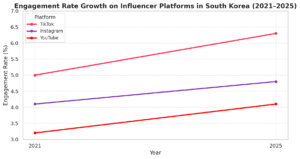
| Platform | 2021 | 2025 | Trend |
|---|---|---|---|
| TikTok | 5.0% | 6.3% | Strongest growth |
| 4.1% | 4.8% | Steady upward trend | |
| YouTube | 3.2% | 4.1% | Improving performance |
TikTok continues to lead South Korea’s engagement landscape, but Instagram and YouTube are catching up. YouTube’s rise reflects the increasing popularity of long-form creator content, while Instagram remains a key player in lifestyle and aesthetic-driven campaigns.
Social Norms Shaping Influencer Marketing in South Korea
South Korea’s influencer economy is monitored by a public that expects accountability, consistency, and humility.
It’s not uncommon for influencers to be “canceled” for promoting too many products, being seen at the wrong venue, or even posting a luxury item during a national tragedy. Public apology videos are not rare—they are part of the expectation.
That’s why brands must vet their influencer partners not only for reach but for social compatibility. Influencer scandals can spill over into the brand’s comment section within hours.
What helps? Understanding “nunchi”—a Korean word that means reading the room or picking up on unspoken social cues. Influencer content in Korea succeeds not because it shouts, but because it senses the right moment to speak.
Marketers are now increasingly relying on Korea influencer marketing tools to assess tone, track creator credibility, and monitor cultural fit before launching collaborations. These tools are especially vital for managing long-term brand equity in high-context markets like South Korea.
Table: Key Social Expectations for Influencer Behavior in South Korea
This table outlines four key South Korean cultural concepts that brands must understand when running influencer campaigns, along with the risks of ignoring them:
| Cultural Concept | Description | Risk for Brands |
|---|---|---|
| Nunchi | Social sensitivity and “reading the room” | Ignoring cultural context or posting at wrong times |
| Jeong | Emotional connection and loyalty | Treating collaborations too transactionally |
| Face (체면) | Public appearance and reputation | Partnering with controversial figures |
| Tone Matching | Using appropriate language | Appearing disrespectful, especially in certain sectors |
Nunchi is the ability to “read the room” socially. Brands risk backlash if they post at inappropriate times or ignore cultural cues. Jeong represents emotional warmth and loyalty. Overly transactional partnerships may feel cold or inauthentic to Korean audiences.
Face (체면) relates to public image and pride. Associating with controversial influencers can damage brand reputation.
Tone Matching refers to using respectful, context-appropriate language. Failing to do so—especially in luxury or healthcare—can come off as disrespectful.

The Power of Localization
Let’s make something clear—translation is not localization.
Localization in South Korea includes:
- Matching tone to product type (e.g., health = formal tone, fashion = semi-casual)
- Understanding regional nuances (Seoul speech ≠ Busan dialect)
- Using local platforms (KakaoStory, Naver Blog, and Coupang Live)
- Avoiding culturally sensitive imagery, metaphors, or slang
For international marketers, knowing which influencer marketing platforms dominate South Korea in 2025 is essential to avoiding missteps and maximizing ROI. These insights guide smarter content mapping across both global and domestic platforms.
Create Local Voices, Make Global Impact—Powered by AWISEE!
Influencer marketing in South Korea is a cultural strategy, not just a media channel. AWISEE helps you localize with precision through:
- Campaign tone that aligns with Korean norms
- Collaborations with K-beauty, K-pop, and lifestyle creators
- Trusted creators fluent in honorifics, visuals, and storytelling
Work with South Korea’s most influential voices—Start your South Korean influencer journey today at awisee.com.
Why Relevance Beats Reach in South Korea
And Why Influencer Tech Platforms in South Korea Are Gaining Ground
Global influencers with 5M+ followers often underperform in Korea when compared to a domestic creator with 100K. Why? Because Korean audiences reward empathy, familiarity, and contextual fluency.
It’s not just what you say. It’s how you say it. And when. And where. That’s why global brands entering this market are leaning into co-creation instead of content control. They don’t dictate scripts—they invite collaboration.
To streamline this process, many global agencies are now turning to influencer tech platforms in South Korea that offer detailed creator profiles, brand affinity scores, and AI-powered content suitability analysis.
Respect, Relevance, and Resonance
Mastering influencer marketing in South Korea requires a simple mindset shift: from brand-centric broadcasting to cultural co-creation. Here, the most successful campaigns don’t disrupt—they belong.
Influencer marketing here is as much a social language as it is a business channel. And if there’s one unspoken rule: be respectful, be relevant, and be resonant. Because in this market, cultural grace travels faster—and deeper—than hashtags ever could.