
North America sets the global benchmark for digital advertising—particularly within the influencer marketing space. With its robust creator infrastructure, high campaign performance metrics, and platform innovation, this region commands more than just attention—it drives global trends.
Influencer marketing in North America is a benchmark in both strategic scale and return on investment. From U.S. tech brands to Canadian ethical labels and Mexico’s mobile-first campaigns, brands here are constantly evolving their creator partnerships.
The U.S. dominates in scale and budget allocation, Canada earns recognition for its inclusivity and consumer trust, while Mexico is experiencing rapid adoption fueled by smartphone penetration and TikTok virality. Together, these markets continue to influence how campaigns are shaped globally—making influencer marketing in North America a leading example of digital maturity.
Country Comparison: Influencer Marketing in the U.S. vs. Canada vs. Mexico

While often discussed as a single region, each North American country has a distinct influencer marketing ecosystem requiring tailored strategies. Brands must tailor their messaging and platform approach to local behaviors.
- United States: The influencer marketing industry in the U.S. is projected to reach $2.1 billion in spend in 2024. With its massive influencer pool and advanced tools, U.S. brands focus on high-volume storytelling. Beauty, fitness, and fintech brands in the U.S. lead influencer collaborations—often using either celebrity creators or trusted niche experts.
- Canada: Known for its bilingual culture and ethical marketing codes, Canadian campaigns often emphasize authenticity and social purpose. Micro-influencers are highly valued, and English-French dual-language content is common.
- Mexico: This fast-growing market is driven by mobile usage and regional content styles. Influencers play a cultural role, using storytelling and humor to bridge the gap between brands and diverse local communities.
This diversity is why successful campaigns consider more than language—they reflect tone, timing, and the fast-evolving nature of influencer marketing in North America, which shift quickly across regions.
Influencer Marketing Spend in North America (2024)

This bar chart visualizes the total influencer marketing spend across the U.S., Canada, and Mexico. It reveals that the U.S. dominates with over $2.1 billion USD, while Canada and Mexico follow with $480 million and $330 million, respectively.
Instagram, TikTok, or YouTube? Top Influencer Platforms for American Brands
Choosing the right influencer platform in North America is essential to success in influencer marketing in North America—it’s as much about culture as functionality.
- Instagram is a powerhouse for visual storytelling, especially in lifestyle, fashion, and beauty. With features like Reels and Stories, it dominates brand collaborations in Canada and the U.S.
- TikTok leads for viral challenges and short-form creativity. It is the go-to platform in Mexico and is rapidly growing among Gen Z in the U.S., thanks to its algorithmic reach and low production requirements.
- YouTube remains essential for long-form campaigns—think product tutorials, explainer videos, and expert reviews. It’s especially effective in tech, education, and personal finance sectors.
These influencer platforms for American brands are now used strategically: TikTok for top-of-funnel engagement, Instagram for aesthetics and aspirational content, and YouTube for depth and conversion. Brands that understand how to align the platform with objectives tend to win across every metric.
Short-Form vs. Long-Form: What Works Best in North American Influencer Campaigns 2025?

In influencer marketing in North America, content length plays a significant role in audience engagement. While short-form content is widely used for impressions and viral reach, long-form content helps drive deeper storytelling and purchase intent.
Short-form (under 60 seconds) thrives on:
- TikTok
- Instagram Reels
- YouTube Shorts
These formats are ideal for brand awareness, trend participation, and rapid promotional bursts.
Long-form (3+ minutes) excels through:
- YouTube videos
- Podcasts
- Livestreams
These formats work well for educational campaigns, in-depth reviews, or cause-driven storytelling.
The best strategies for influencer marketing in North America in 2025 are increasingly hybrid. Brands start with short-form to grab attention, then follow up with long-form anchors that build trust, demonstrate product use, and influence conversion.

Partner with the Best Influencers in the U.S., Canada, and Mexico
AWISEE ranks among the leading influencer marketing agencies in North America, offering end-to-end campaign execution. We offer:
- Hyper-local influencer curation
- Full campaign setup & reporting
- Long-term influencer collaboration strategies
With AWISEE, partner with top-tier creators and watch your engagement soar.
What Makes a Great Influencer Brief in North America?
You could have the best product and the perfect influencer, but if your brief is unclear, it will show.
Here’s what a strong North American influencer brief should include:
- Campaign objectives (reach, awareness, conversions)
- Content style and tone expectations
- Platform-specific formats
- Creative flexibility
- Legal clauses on disclosure, exclusivity, and paid usage
In influencer marketing in North America, top-performing brands treat the brief as a collaboration blueprint, not a rulebook. That’s one reason why the best influencer collaboration strategies in North America allow influencers to shape the story while staying aligned with brand goals.
FTC & ASA Rules for Sponsored Content in North America

Let’s get one thing clear—influencer marketing in North America doesn’t work without compliance. Across North America—from Toronto to Texas—transparency in influencer marketing in North America is non-negotiable.
In the United States, the Federal Trade Commission (FTC) requires that all influencers clearly disclose paid partnerships. This means no hidden hashtags, no vague mentions, and definitely no back-end disclaimers. The rules insist that disclosures must be:
- Clear and unambiguous
- Visibly placed at the beginning of the content
- Spoken and/or written, depending on the format
Meanwhile, Canada follows the Canadian Code of Advertising Standards, enforced by Ad Standards Canada. These guidelines go even further, recommending terms like “Paid Partnership” or “Advertisement” instead of just hashtags. Terms like #collab or #sponsored alone may not be considered sufficient.
What many still find surprising is how major influencers still get this wrong—hiding tags in captions, using ambiguous wording, or failing to disclose content repurposed across platforms. The safest approach? Customize your legal disclosure strategy to each country’s expectations and keep it crystal clear.
Stay Compliant. Stay Confident.
Navigating FTC and ASA rules? AWISEE ensures every campaign meets regional standards—so your brand stays protected and your message reaches audiences the right way.
Whether you’re launching in Mexico or scaling across Canada, AWISEE ensures you collaborate with influencers that align with your values, goals, and growth roadmap.
How US and Canadian Brands Use Influencer Marketing in 2025
The way US and Canadian brands use influencer marketing in 2025 reflects a major shift: from reach to relevance.
Gone are the days when follower count was everything. Today, nano- and micro-influencers are at the heart of impactful campaigns. These creators have small but highly engaged communities and are often seen as more authentic and trustworthy.
Many brands are also pivoting to affiliate-style partnerships instead of flat-fee posts. This is especially prevalent in industries like wellness, fashion, and DTC tech, where influencers are rewarded based on conversions or clicks.
And here’s where things get even more interesting:
- In Canada, healthcare and education-focused brands work with licensed professionals to build credibility.
- U.S. finance and tech brands partner with influencers who demystify complex topics like investing or software tutorials.
- Both markets are increasingly focused on inclusive content, with diverse creators leading the charge in beauty, lifestyle, and sustainability campaigns.
This evolution reflects broader social media trends in North America, where connection and credibility drive conversions far more than celebrity endorsements.
Measuring Influencer Marketing In North America
With so many campaign types and goals, how do brands measure what matters?
In North American influencer campaigns 2025, vanity metrics like likes and impressions still matter—but they’re not enough. The real indicators of success include:
- Cost Per Engagement (CPE)
- Earned Media Value (EMV)
- Conversion rates and return on investment (ROI)
The U.S. leads in analytics adoption, using tools like Grin, Traackr, and CreatorIQ to monitor everything from swipe-ups to Story exits. Canada takes a slightly more qualitative approach, often valuing content saves, meaningful comments, and direct messages as signs of engagement.
In Mexico, measurement maturity is evolving, but reach and brand awareness are still prioritized, especially on mobile-first platforms like TikTok.
The takeaway? Influencer reporting is no longer about a final wrap-up deck. It’s about real-time dashboards and dynamic tracking, enabling mid-campaign optimizations and smarter spending.
Social media trends in North America: Emerging Trends
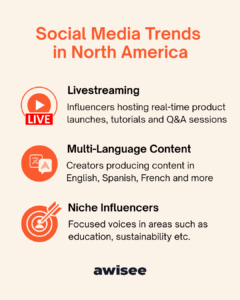
Livestreaming is redefining engagement in influencer marketing in North America. Influencers are hosting real-time product launches, tutorials, and Q&A sessions—driving immediate interaction and impulse purchases.
A growing number of creators also now produce multi-language content. It’s not unusual to see an Instagram carousel in English, followed by TikTok videos in Spanish or French. For multinational campaigns, this strategy allows one influencer to resonate in multiple markets, without losing cultural nuance.
Another standout trend? The rise of niche and community-based influencers. From ADHD educators in Canada to sustainability advocates in the U.S. and regional food experts in Mexico, these focused voices are increasingly in demand. Brands are realizing that small, mission-aligned communities often convert better than large, generic followings.
If you’re building a long-term strategy, these insights are the foundation of the best influencer collaboration strategies in North America today.
The Future of the Creator Economy in North America
So what’s next for the creator economy?
In the United States, creators are pushing for greater control through unionization talks, creator funds, and even co-branded product ownership. They’re moving beyond paid posts and toward genuine business partnerships with brands.
Canada presents a more nuanced picture. With lower platform payouts and bilingual demands, creators often juggle more while earning less. But they’re adapting by partnering on digital products, launching e-books, courses, and even proprietary skincare lines with local labels.
And Mexico? It’s going full speed ahead. Regional creators are becoming brand founders, signing exclusive content deals, and growing multi-platform empires. It’s no longer just about being an influencer—it’s about becoming a media brand.
Ultimately, influencer marketing success in North America hinges on seeing creators not as contractors, but as strategic collaborators. Because the most successful creators today? They’re not waiting for opportunities. They’re building them.