In 2025, impulse buying is more emotional, digital, and fueled by real-time triggers than ever before.
Impulse Buying Statistics 2025 show that spontaneous shopping, fueled by AI-driven impulse shopping psychology, has grown beyond in-store candy racks or seasonal sales. It’s now powered by AI-driven platforms, mobile checkouts, and personalized recommendations. From social media swipes to one-tap purchases, this behavior is deeply reshaping modern retail.
AWISEE Handles It All – From Search to Strategy
AWISEE delivers full-service influencer marketing—from scouting and vetting to campaign management and reporting—so your brand can turn spontaneous shoppers into loyal customers.
What is Impulse Buying?
Impulse buying is a spontaneous purchase made without prior planning—often sparked by a sudden emotional trigger rather than a shopping list.
Psychologists link this to instant gratification. That feel-good moment? It often comes from a quick dopamine boost especially when we’re stressed, bored, or simply scrolling through social media.
There are four major types of impulsive purchase behavior:

- Pure Impulse Buying – Completely unplanned, often triggered by surprise or joy
- Reminder Impulse Buying – Sparked by seeing a product that reminds the shopper of a need
- Suggestion Impulse Buying – Influenced by a recommendation, ad, or influencer
- Planned Impulse Buying – The buyer plans to get something but chooses the actual product on the spot
Understanding these patterns helps both marketers and mindful consumers.
Impulse Buying Statistics 2025: Key Numbers to Know
Impulse buying in 2025 continues to grow as a driving force in global commerce. Here are some standout impulsive buying statistics collected by AWISEE from various sources like Invesp and Fit Small Business,
- 84% of shoppers admit to making impulse purchases
- 40% of all online spending now comes from impulse buys—a sign that emotional decisions are dominating checkouts
- More than half of U.S. shoppers (54%) have spent $100 or more impulsively. And astonishingly, 1 in 5 spent over $1,000
- The average U.S. consumer spends $150 per month on unplanned purchases
- In stores, shoppers make about 3 impulse buys every 10 visits
These impulse buying statistics 2025 confirm that unplanned spending remains embedded in shopping behavior, especially in digital environments.
Summary of Impulse Buying Statistics 2025
Here is a summary table of impulsive buying statistics and the following figures are collected by AWISEE from various sources:
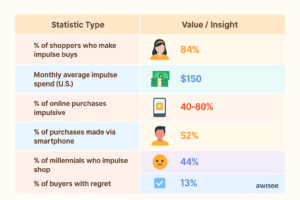
This table summarizes the most important data points from the article. It covers overall impulsive shopper percentages, average monthly spend, channel-specific data like mobile usage and BNPL impact, and demographic highlights (e.g., millennials). The table offers a snapshot that supports the narrative on how widespread and strategic impulse buying is in 2025.
Breakdown of Impulse Spending by US Shoppers (2025)

Insights: Shows estimated distribution:
- 46% spent under $100
- 34% spent between $100–$999
- 20% spent over $1000
Impulse Buying Habits 2025: Who’s Doing It & How Often?

Not all shoppers behave the same way when it comes to impulse spending trends. Take a look at the following impulsive buying statistics collected by AWISEE:
- Single shoppers are 45% more likely to make impulsive purchases than married ones
- Millennials top the list of spontaneous shoppers, with 52% admitting to frequent impulse buying
- During shopping holidays like Black Friday and Cyber Monday, women are more likely than men to buy impulsively
Quick Snapshot:

These consumer impulse buying trends highlight how personal lifestyle, relationship status, and timing shape buyer behavior.
Impulsive Purchase Behavior: Triggers and Motivators
People rarely buy impulsively for no reason. In 2025, most impulse buys happen when three things align: motivation, ability, and a well-timed trigger—often tied to the psychology of impulse buying.
What Triggers Impulse Buying Behavior in Digital Shopping 2025?

According to Forbes:
- Motivation: Often emotional—rooted in joy, stress, or boredom
- Ability: The shopper feels they can afford it, even if it’s a “treat”
- Trigger: A nudge like a flash sale or influencer recommendation
Common retail triggers include:
- Scarcity: “Only 3 left in stock!”
- Urgency: “Offer ends in 30 minutes”
- FOMO: “Everyone’s buying this”
Underlying it all is hedonic motivation. People want:
- Fun
- Excitement
- Delight
- Thrill
- Instant satisfaction
No wonder an impulse shopper would grab a quirky cat pillow over a practical one.
Ecommerce Impulse Purchases: Trends Driving Online Sales
Today’s online shopping environment is engineered for real-time impulse shopping behavior, fast decisions, and emotional reactions. Data collected by AWISEE shows that:
- Between 40% to 80% of e-commerce purchases are unplanned. Even the conservative estimate signals a significant behavioral shift.
- Offering Buy Now, Pay Later (BNPL) boosts impulse conversion rates by 13%.
- Free shipping is the #1 driver for closing online sales—cited by over 53% of consumers/
- Smartphones dominate spontaneous shopping, driving 79% of purchases during major retail events.
These ecommerce impulse purchases underscore how important fast UX, perks like free shipping, and mobile-first strategies have become for brands.
Key Impulse Buying Statistics in 2025

Categories:
- Shoppers who buy impulsively (84%)
- % of online spending from impulse buys (40%)
- $150 average monthly spend per shopper
- 79% mobile purchases during events
Impulse Buying Statistics – Gender, Generational, and Digital Trends in 2025
Do men or women make more impulse purchases in 2025?
You might think women dominate impulsive shopping but the actual impulse buying statistics present a more balanced picture. Data collected by AWISEE reveals that:
- Men spend more per transaction. Men average $105 per impulsive online buy, while women spend about $71.
- Women are more responsive to seasonal deals. 22% of women make impulse buys during events like Black Friday, compared to 17% of men.
- Post-purchase regret varies too: 52% of women admit regret, while only 46% of men do.
So while men contribute to higher average orders, women show stronger emotional engagement especially during promotional seasons.
Consumer Impulse Buying Trends by Generation
Let’s talk generational dynamics.
Millennials and Gen Z lead consumer impulse buying trends, but their methods vary:
- Millennials are still the top spontaneous shoppers—52% of them admit to making frequent impulse purchases.
- Millennials shop via Facebook, while Gen Z prefers TikTok and Instagram—especially with the rise of social commerce. According to AWISEE, 68% of Gen Z prefer shopping on mobile phones over other devices
- Across both groups, mobile-first behavior rules. Platforms like TikTok Shop and Instagram Reels are major entry points for online shopping impulse stats.
What Role Do Emotions Play in Impulse Buying Behavior?
It’s not always rational, it’s emotional.
Impulse decisions are tied to how we feel. When the brain’s nucleus accumbens is activated (our reward center), we’re more likely to click “Buy Now.”
Common emotional triggers include:
- Boredom
- Stress
- Loneliness
- The need for self-reward
For many, impulse shopping is a form of self-soothing—driven by emotions like boredom, stress, or loneliness.
How Common Is Impulse Buying in 2025?
Let’s look at the numbers collected by AWISEE:
- A staggering 84% of consumers have made impulse purchases.
- But spending is softening. The average monthly spend on impulse buys fell to $150 per person in 2024.
This doesn’t mean impulse buying is disappearing, just that impulse spending trends are shifting due to inflation and buyer caution.
How Do Social Media and Influencers Impact Impulse Purchases in 2025?

The connection is stronger than ever.
- Platforms like TikTok and Instagram are now primary discovery tools, especially among Gen Z and millennials.
- Influencers drive real-time sales through livestreams, haul videos, and shoppable content.
What Is the Impact of Discounts and Promotions on Impulse Buying?
Huge.
- Limited-time offers trigger instant decisions.
- Black Friday and Cyber Monday see a sharp spike in spontaneous buying especially among women.
- Combining urgency, scarcity, and emotion is still the golden formula driving impulse buying statistics 2025.
How Retailers Optimize for Impulse Purchases in 2025
Retailers are designing experiences with impulse buying habits 2025 in mind.
Here’s how they do it:
- Frictionless checkout (1-click, BNPL, digital wallets)
- AI-driven product suggestions (e.g., Amazon Interests AI)
- Emotionally charged UX with urgency tags, bright visuals, and limited offers
- Shoppable content integration on TikTok, Instagram, and Instacart
EMARKETER notes that platforms are now using AI and seasonality to engineer spontaneous buying behavior.
Impulse Buying: Regret, Returns & Coping Mechanisms
Impulse purchases aren’t always satisfying.
- 44% of buyers feel regret post-purchase.
- 17% now prefer curbside pickup to avoid being tempted in-store.
- Strict return policies are losing favor; flexibility builds brand trust.
Popular coping strategies include:
- Wishlist delays
- Cart reminders
- No-spend challenges
- Budget tracking apps
Impulse Buying Statistics 2025: What Does It Reveal?
In 2025, Impulse Buying Statistics reveal a more calculated yet emotionally driven buyer. Consumers are still making unplanned purchases, but increasingly via mobile, social media, and with the help of influencers and algorithms.
According to AWISEE, “While impulse buying habits are adapting to economic shifts, retailers are becoming smarter in how they trigger them. The future of impulse shopping isn’t about elimination; it’s about optimization.”
And as impulse buying statistics 2025 show, success lies in balancing emotional triggers with consumer trust.