
How Much Do YouTubers Make is one of the most misunderstood questions in the creator economy. In 2025, YouTube is no longer just a video platform. It is a complex business ecosystem where YouTube income depends on data, strategy, and audience value. Many people assume subscriber count determines YouTuber salary, but real YouTube creator earnings tell a different story.
How Much Do YouTubers Make in 2025 is not a single answer. It is a range. YouTube income varies widely across creators, even within the same niche. Some earn a side income. Others build full-time businesses. A very small percentage reach extreme levels of YouTube revenue.
Some channels with modest audiences earn more than creators with millions of subscribers. Others struggle despite consistent uploads. Average YouTuber earnings are not fixed numbers. They fluctuate with advertiser demand, content type, and platform rules. This article breaks down how much do YouTubers make using verified statistics only.
Turn Views Into Predictable YouTube Income
AWISEE helps creators improve discoverability and RPM through YouTube SEO, while unlocking brand deals with targeted YouTube influencer marketing.
How Much Do YouTubers Make in 2025? A Reality Check on YouTube Income
Let’s start with the most honest answer. Most creators do not earn a full-time YouTuber salary. According to Riverside, only 0.3% of YouTubers earn $5,000 or more per month.
That single statistic resets expectations about average YouTuber earnings. This does not mean YouTube income is impossible.
It means YouTube rewards structure, consistency, and scale, not luck.

The Typical YouTube Income Range Per 1,000 Views
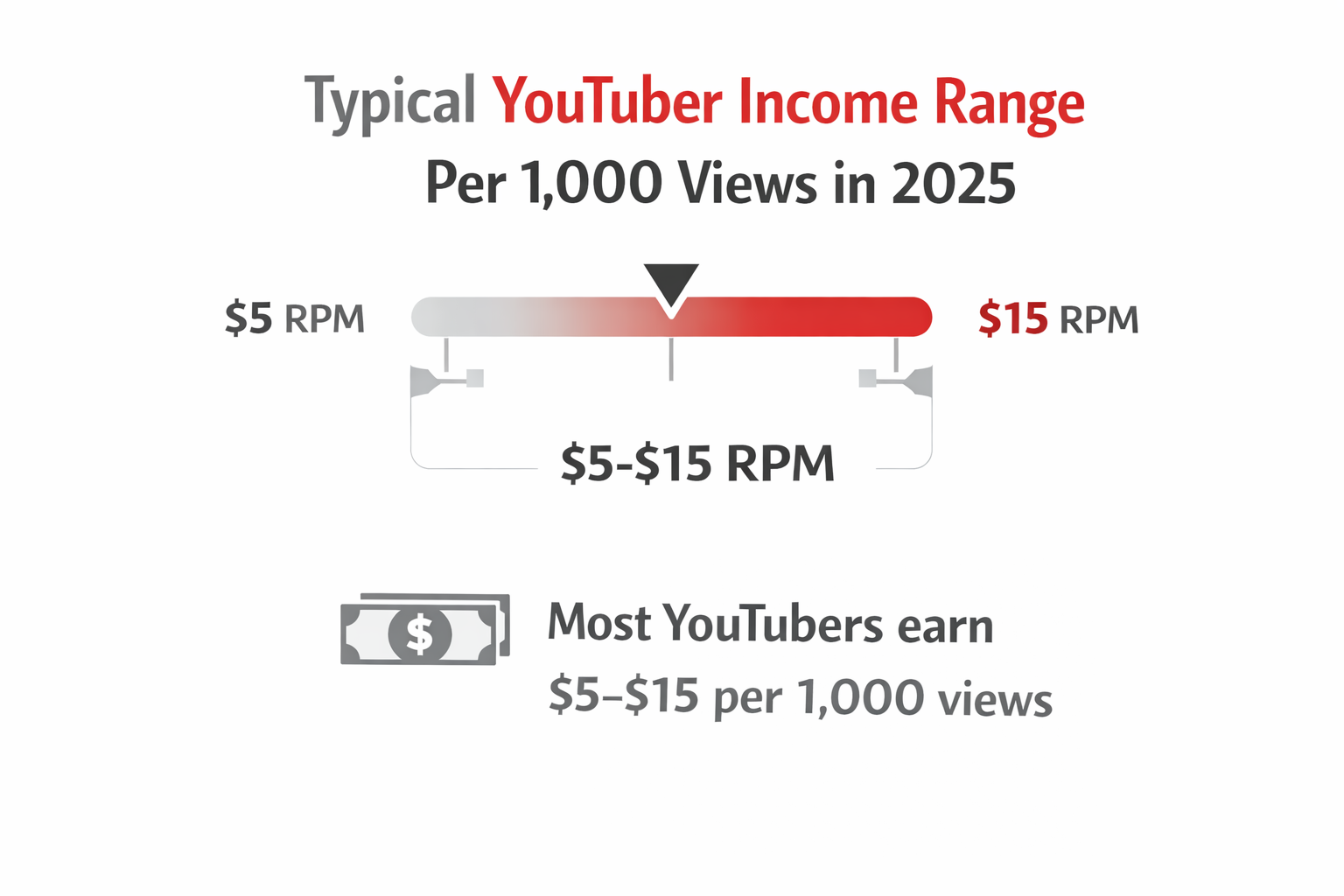
In 2025, most YouTube creator earnings fall within a broad range.
- $5 to $15 per 1,000 views (RPM) is typical
This range reflects real YouTuber earnings 2025 across niches.
Why such a wide range in YouTube revenue?
Because:
- Finance and tech audiences attract higher advertisers
- U.S. viewers increase YouTube income
- Longer videos allow more ads
- Q4 ad budgets outperform January
Same views. Very different YouTube monetization outcomes.
Subscriber Count Does Not Define YouTuber Salary
This is one of the biggest myths in YouTube monetization. Subscribers help distribution. They do not guarantee YouTube income.
A channel with:
- 20,000 loyal viewers in a high-paying niche
can outperform:
- 200,000 subscribers with low engagement
YouTube revenue follows viewer intent, not vanity metrics. That is why How Much Do YouTubers Make should always be evaluated using:
- Views
- Watch time
- Audience location
- Monetization mix
Not subscriber screenshots.
How YouTube Ad Revenue Works (AdSense Explained Simply)
Data collected from AWISEE shows that YouTube Becomes World’s #2 Most Visited Website in 2025. AdSense is the foundation of YouTube income. It is also the most misunderstood part of YouTube monetization.
What You Need to Start Making YouTube Revenue
To earn YouTube creator earnings from ads, you must join the YouTube Partner Program (YPP).
You qualify if you have:
- 1,000 subscribers, and either:
- 4,000 public watch hours in the last 12 months, or
- 10 million Shorts views in the last 90 days
These requirements are confirmed by both Riverside and Descript. Once approved, ads can appear on your videos and generate YouTube revenue.
CPM, RPM, and CPC: The Metrics That Decide How Much YouTubers Make

These three metrics determine YouTube income.
CPM (Cost Per Mille)
- What advertisers pay YouTube per 1,000 ad impressions
CPC (Cost Per Click)
- What advertisers pay when a viewer clicks an ad
RPM (Revenue Per Mille)
- What creators earn per 1,000 views after YouTube’s cut
YouTube keeps 45% of ad revenue.
Creators receive 55%.
RPM is the number that defines real YouTuber earnings.
A Simple Example of YouTube Ad Earnings (Real Numbers)
Let’s look at a real example from Riverside.
A video receives 5,000 views:
- 2,500 views show ads (CPM = $10)
- 100 viewers click ads (CPC = $0.50)
Revenue breakdown:
- CPM earnings: $25
- CPC earnings: $50
- Total before YouTube cut: $75
After YouTube takes 45%:
- Creator keeps $41.25
That equals:
- $8.25 RPM
This example shows why:
- Views alone do not define YouTube income
- Audience value matters
- Ad quality affects YouTube revenue
Factors That Change YouTube Monetization Outcomes
Two creators can earn from AdSense. One consistently earns more. Here is why.
Niche Matters More Than Views
Advertisers pay more for certain audiences.
Higher-paying niches include:
- Personal finance
- Technology
- Software
- Business
- AI tools
Lower-paying niches often include:
- Gaming
- Comedy
- Vlogs
- General entertainment
Descript confirms niche is the single biggest driver of RPM.
Audience Location Changes YouTube Income
A view from the U.S. is worth more than most regions.
Advertisers pay more to reach:
- United States
- Canada
- United Kingdom
- Western Europe
Descript notes a U.S. view can be worth 2–3x more than a lower-income market. This is why subtitles and global accessibility increase YouTube revenue.
Video Length Unlocks More Ads
Videos longer than 8 minutes allow mid-roll ads. More ad slots increase YouTube income potential.
But:
- Retention matters
- Engagement controls ad impressions
Ad density without attention does not work.
Seasonality Affects Average YouTuber Earnings
Ad budgets peak in:
- October
- November
- December
They often drop in January. Descript confirms Q4 delivers the highest CPMs. Smart creators plan YouTube monetization around this cycle.
Earnings by Channel Size: What the Numbers Actually Show
Riverside estimates:
Beginner Stage: Around 1,000 Subscribers
- $30–$300 per month from AdSense
Descript adds:
- Many new creators earn $20–$200 per month
This stage is about learning, not YouTuber salary.
Growth Stage: Around 100,000 Monthly Views
At this level:
- AdSense can reach $1,000–$3,000 per month
- A 100,000-view video may generate $500–$2,000 gross
- Creator keeps $250–$1,000 after YouTube’s cut
This is where many creators move toward part-time YouTube income.
Established Channels: How Much Do YouTubers Make at 1 Million Subscribers
At scale, How Much Do YouTubers Make becomes a very different question. Once a channel reaches around 1 million subscribers, YouTube income changes structurally. Creators at this level can earn $10,000+ per month from AdSense alone
That figure represents only ad revenue, not total YouTube creator earnings. However, most creators at this level do not rely on ads alone.
They usually:
- Secure regular sponsorships
- Sell products or services
- Build teams
- Treat YouTube monetization as a business system
AdSense becomes meaningful. But it is rarely the whole YouTuber salary.
Celebrity-Scale Channels: YouTube Revenue at 50 Million+ Subscribers
This level is rare. Extremely rare.
Riverside reports that:
- Only around 30 creators globally have more than 50 million subscribers
- Annual YouTube revenue at this level reaches tens or even hundreds of millions
At this scale:
- YouTube is not the product
- The creator becomes the brand
- Revenue flows from multiple businesses
These channels operate like media companies, not hobby projects.
Affiliate Marketing: YouTube Revenue Without Ads
Affiliate income works differently from ads. Creators earn when viewers purchase recommended products.
Key characteristics:
- Commission rates typically range from 5% to 50%
- Earnings depend on trust, not raw views
- Works best for tutorials, reviews, and comparisons
YouTube affiliate tagging becomes available at 15,000 subscribers. Many creators report higher YouTube income from affiliates than from AdSense at the same view level.
Memberships, Patreon, and Recurring YouTube Monetization
Recurring income changes financial stability.
Options include:
- YouTube channel memberships
- Patreon-style subscriptions
YouTube takes a 30% cut of channel membership fees. Creators still use memberships because:
- Monthly income is predictable
- Communities become stronger
- Algorithm dependency decreases
Recurring revenue smooths YouTube income volatility.
Digital Products and Services: High-Leverage YouTube Revenue
Some creators skip merch entirely. They monetize expertise instead.
Examples include:
- Online courses
- Consulting
- Coaching
- Agency services
These creators use YouTube as a distribution channel, not the final product. This model works especially well for:
- Marketing
- Business
- Education
- Technology
- Fitness
YouTube becomes the top-of-funnel for high-margin offers.
Highest-Paid YouTubers: What Top Earners Have in Common
Riverside lists examples such as:
- MrBeast (~$700M/year estimated)
- Jeffree Star (~$200M/year estimated)
- Like Nastya (~$106M/year estimated)
Important context:
- These are estimates
- They include businesses beyond YouTube
- They represent outliers, not averages
They show what is possible, not typical average YouTuber earnings.
What Actually Determines How Much Do YouTubers Make
YouTube rewards systems, not luck.
Creators who earn more usually has the following things in common:
- Study RPM, not views
- Choose high-value niches
- Diversify income early
- Treat YouTube like a business
Rank Higher, Earn More on YouTube
AWISEE helps creators rank for high-value keywords, optimize watch time, and attract advertisers through proven YouTube SEO strategies.