
AI-driven discovery is changing how people find information online. Instead of browsing long lists of links, users now rely on ChatGPT, Google Gemini, Perplexity, and Claude to summarize content from across the web and deliver instant answers. This shift makes AI citations one of the most important visibility signals for any brand in 2026.
Get Cited By AI has become a major priority for businesses that want their insights to appear inside AI-generated responses. When LLMs include your content in their answers, your brand becomes part of the information users see every day. As more people ask AI tools the same questions, those citations begin shaping your brand’s reputation and authority.
That’s where AI citation optimization becomes essential. Improving your content structure, strengthening entities, and publishing information that AI models can interpret easily all help increase the likelihood of being cited. The stronger and more consistent your online presence is, the more AI systems view it as reliable.
Passionfruit noted that AI platforms cite content that’s 25.7% fresher than traditional search results. AI-driven search has elevated the importance of citation-ready content, and brands now need a more technical strategy to earn visibility inside LLM outputs. This article breaks down the five core techniques that determine whether an AI model chooses your website as a reference point when delivering answers.

Tip #1 – Build Authoritative Content Hubs to Get Cited By AI
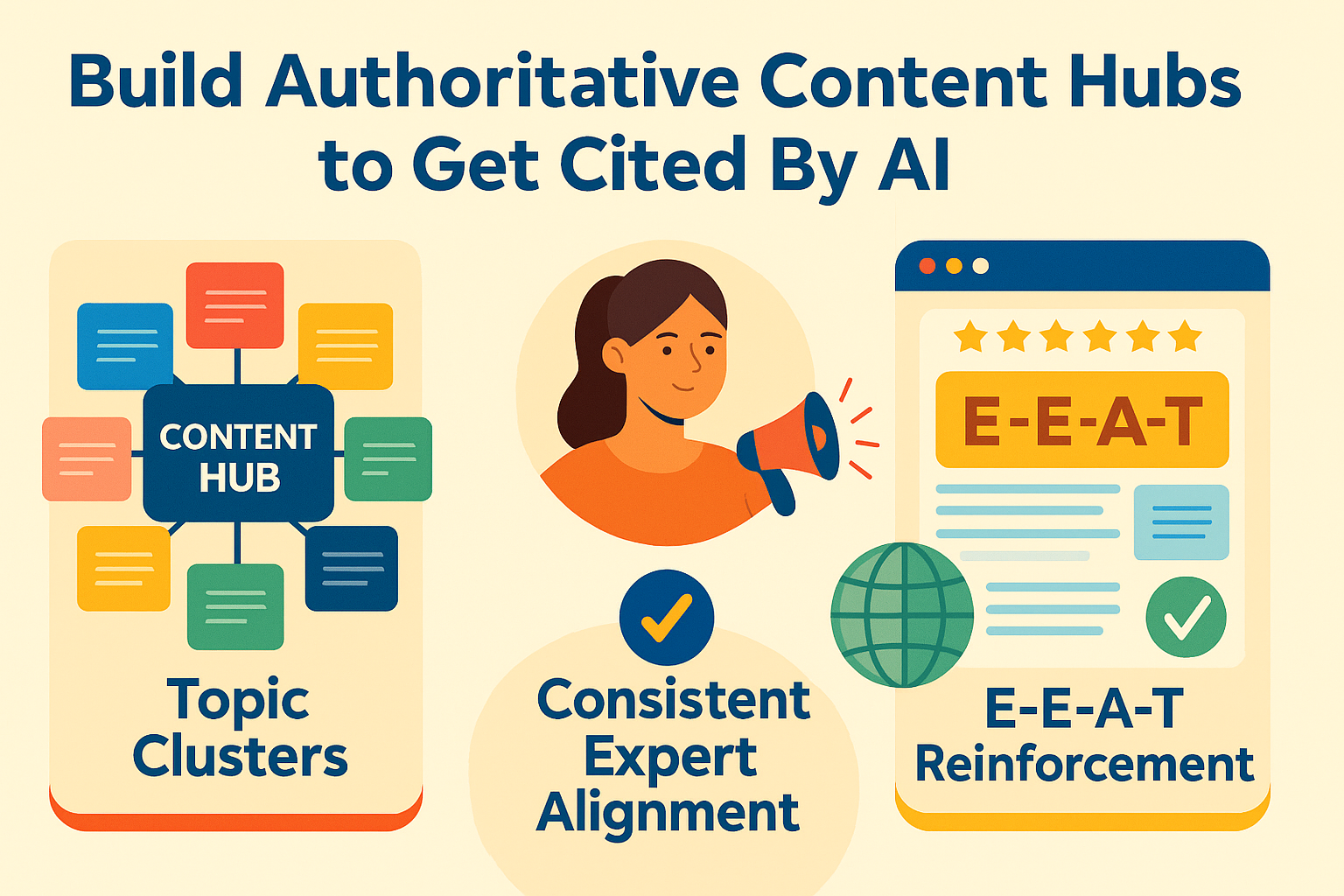
Publishing random stand-alone articles is no longer enough. To Get Cited By AI, your content must form a structured ecosystem. LLMs prefer websites that demonstrate strong topical authority.
Why Topic Authority Has Become the #1 AI Ranking Signal
AI models evaluate how deeply you cover a subject. Building clusters of related content helps LLMs understand your expertise.
Key elements include:
- Topic clusters
Organizing related articles around one theme strengthens subject authority. - Consistent expert alignment
Your content should communicate the same level of expertise across each piece.
Cross-confirmation across the web
If other websites reference your insights, AI systems treat your content as more trustworthy.
E-E-A-T Reinforcement for LLM Models
AI systems prioritize sources that demonstrate Experience, Expertise, Authoritativeness, and Trustworthiness.
Here’s what LLMs evaluate:
- Signals used by ChatGPT + Gemini
Author profiles, credentials, third-party mentions, and topic depth all help LLMs verify credibility. - Role of authorship and brand identity
Consistent author names, brand details, and organizational information make your content easier for AI to trust.
Increase Your AI Citation Visibility
If ChatGPT, Gemini, and Perplexity aren’t referencing your content, you’re losing visibility.
AWISEE helps your content get cited by AI through advanced AI SEO and cross-platform trust-building strategies.
Tip #2 – Strengthen Entities & Structured Data for Better AI Search Visibility
Entities help LLMs understand what your content represents. If entity signals are unclear, AI models struggle to classify and reuse your information.
The Role of Structured Data in Earning AI Citations
Structured data provides AI systems with a precise map of your content. Schema markup outlines your brand, authors, products, and topics, helping AI interpret your information correctly.
Why structured data matters:
- Faster content classification
- Improved entity recognition
- Better topic clustering
- Stronger links to external data sources
- Greater consistency across search engines and LLMs
The more organized your structured data is, the easier it becomes for platforms like ChatGPT, Gemini, and Perplexity to map your brand inside their knowledge graphs.
Entity Optimization (Brand, Author, Product, Topics)
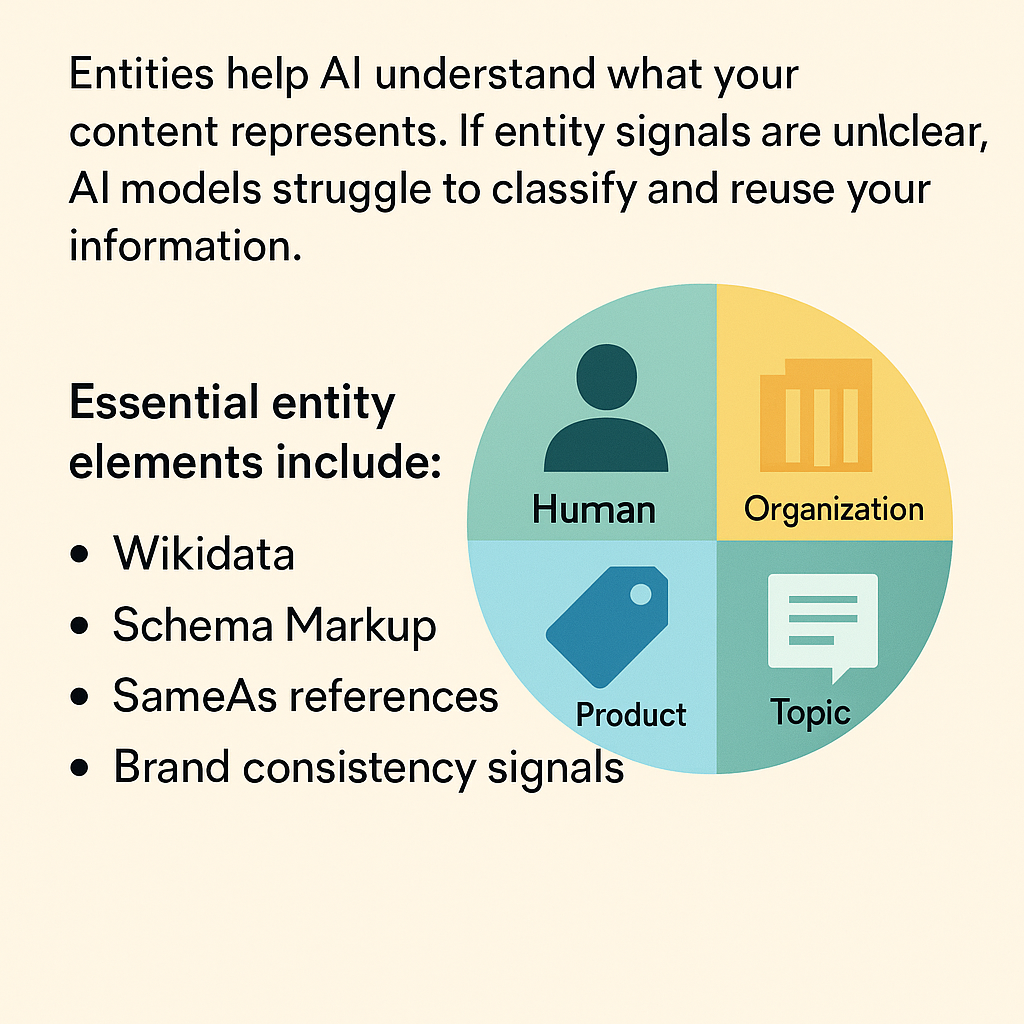
LLMs rely heavily on clear entity information. Without it, your content becomes harder for AI to trust.
Essential entity elements include:
- Wikidata
Helps AI models verify your brand through public databases. - Schema Markup
Adds structure to your pages, authors, and content categories. - SameAs references
Connects your brand to verified external profiles such as LinkedIn, Crunchbase, or YouTube. - Brand consistency signals
Ensures your brand identity remains uniform across platforms.
Tip #3 – Improve LLM Citation Strategy with Multi-Source Web Validation
AI models trust information that appears consistently across credible platforms. This is why using a strong LLM Citation Strategy is essential.
Why AI Requires Cross-Platform Signal Consistency
LLMs validate your information by comparing it across multiple websites. When identical facts appear repeatedly, AI systems consider them more reliable.
- LLMs verify information across many URLs
- Consistent information improves trust
- Conflicting details reduce reliability—even when your version is correct
A broad and consistent online footprint makes it easier for AI systems to cite your content.
Publishing Across High-Authority Channels
Publishing on high-authority websites is one of the strongest ways to Get Cited By AI. When your insights appear on trusted sources, LLMs view your information as more credible. If your content exists only on your own site, AI models may struggle to confirm its reliability. But once your ideas are validated across respected publications, your chances of being cited increase significantly.
Here are some of the most reliable places to publish:
- Guest posts on industry-leading websites
- Press mentions from reputable news organizations
- Thought leadership articles in recognized digital publications
- Academic or journal references
- Data-backed reports shared through trusted platforms
These external confirmations act like credibility signals. The more consistent your presence is across authoritative websites, the easier it becomes for AI systems to reference your insights with confidence.
Tip #4 – Optimize Content for AI Search (SEO for ChatGPT/Gemini)
Optimizing content to Get Cited By AI requires a different approach than traditional SEO. Instead of focusing on keyword rankings, AI models look for clear meaning, structured insights, and consistent facts. This shift means your content must be easy for LLMs to evaluate, summarize, and reuse.
AI Search Optimization vs. Traditional SEO
AI models use a unique evaluation system that differs dramatically from search engines like Google. Some of the biggest differences include:
- Ranking logic: Instead of ranking pages, AI evaluates trust, clarity, and entity strength.
- Summary extraction: LLMs pull concise answers from multiple sources instead of listing links.
- Entity processing: Brands with well-established entity structures appear more frequently in AI summaries.
Traditional SEO relies on backlinks and page authority. AI Search relies on meaning, structure, and cross-verification across multiple sources. Businesses that adapt early gain a stronger advantage in AI search optimization.
How ChatGPT, Gemini, Claude, and Perplexity Interpret & Surface Content
While each AI model evaluates content differently, they share several core patterns:
- Evidence preference
AI systems favor content supported by data, citations, or structured insights. - Neutral tone patterns
Objective and fact-based writing is more likely to be reused by LLMs. - Source clustering
When different websites present matching facts, AI becomes more confident and more likely to cite them. - API-based content selection
Some platforms, like Perplexity, rely on real-time crawling and APIs to validate accuracy.
Understanding these patterns helps you create content that aligns naturally with the signals LLMs check before citing any source.
Tip #5 – Create Data, Insights & Original Research That LLMs Prefer to Cite
Producing original research is one of the most effective ways to Get Cited By AI. AI models love information that stands out — unique data, surveys, benchmarks, and frameworks. These formats are easier for LLMs to reuse because they contain factual clarity.
Also, LLMs tend to cite content with structured evidence and numerical details more often.
Why LLMs Reward Statistical, Structured, or Analytical Content
LLMs prefer content that is:
- Factual and measurable
- Numerically clear
- Easy to summarize
This makes structured insights perfect for AI citations. When your content includes frameworks, tables, or formulas, AI models can extract and reuse your insights more accurately.
The “Citable Content” Checklist
If your goal is to Get Cited By AI, these content types work best:
- Proprietary data
- Annual surveys
- Industry reports
- Clear step-by-step frameworks
- Real-world case studies
These formats become strong reference points because they contain information other websites rarely duplicate.
How LLMs Discover & Evaluate Content (Foundation for Getting Cited)
Understanding how LLMs process information helps you adjust your content for better visibility. Unlike traditional search engines that depend heavily on keywords, AI systems focus on meaning, semantic structure, and entity relationships.
How AI Search Engines Crawl, Read & Rank Information
LLMs use several techniques to interpret online content:
- Entity-based understanding
AI identifies brands, people, products, and concepts to map knowledge clearly. - Semantic interpretation instead of keywords
LLMs analyze intent, relationships, and sentence meaning—not just keyword matches. - Pattern detection and summarization
AI compares multiple sources, identifies overlapping information, and selects the most consistent version.
Trust signals from multiple web sources
Content that appears across reputable domains is more likely to be cited.
Key Factors LLMs Use to Select “Trusted” Sources
AI tools filter information carefully. They look for credibility, accuracy, and consistency. When the same information appears across respected websites, LLMs treat those sources as more reliable. Key trust indicators include:
- Repeated information across authoritative sources
- Clear entity structures (brand, author, organization)
- Accurate and complete schema markup
- High-quality external references
- Stable publishing history
- Evidence-based content like data and research
- Neutral, factual writing tone
When your website aligns with these trust signals, the likelihood of appearing in AI-generated responses increases dramatically.
Advanced AI Citation Optimization Techniques (2026)
AI systems evolve every year, and the criteria they use to select trustworthy content become more advanced. To strengthen your presence, you must adapt to these updated expectations.
AI Citation Ranking Factors That Matter Most in 2026
Here are the most influential AI citation ranking factors:
- Freshness: AI favors content updated within the last year or two.
- Consistency: Conflicting information decreases trust.
- Entity validation: Verified brands outperform unclear identities.
- Author authority: Named and credible authors rank higher.
- Multi-source confirmation: Repeated facts across multiple domains increase citation likelihood.
Reinforcing Brand Presence Across AI Knowledge Graphs
AI knowledge graphs connect brands, concepts, authors, and topics. Strengthening your presence inside these systems helps LLMs trust your information.
Ways to reinforce this include:
- Google Knowledge Graph: Maintain accurate structured data and entity details.
- OpenAI Index: Ensure your content is consistent and easy for AI to read.
- Perplexity citations: Publish data-focused content that AI can verify.
- Search engine entity APIs: Use APIs to formalize your brand identity online.
A strong presence in knowledge graphs ensures your content is more visible across AI platforms and has a better chance of get Cited By AI.
How to Track Whether LLMs Are Citing Your Brand
According to Ahrefs, “76.10% of AI Overview-cited pages rank in the top 10.” Monitoring whether you Get Cited By AI is becoming a standard part of digital strategy. Several simple tools and methods can help you check your visibility.
- AI visibility tools: Platforms like BrandRadar show where AI references your information.
- LLM output monitoring: Testing controlled prompts reveals whether AI assistants use your content.
- Geo-ranking reports: These reports show regional changes in your AI visibility.
- Custom prompt testing: Running multiple prompts helps track how often your insights appear.
Each method helps measure how strongly your content performs inside AI ecosystems.
Make Your Content “AI-Citation Ready”
AWISEE can help your content get cited by AI with structured data, entity optimization, and E-E-A-T-driven improvements.