

Understanding DeepSeek AI Statistics is essential for anyone tracking the future of artificial intelligence in 2025. The AI market is no longer defined only by scale. It is defined by efficiency. DeepSeek entered the market with a clear thesis. Powerful AI models can be built cheaper. They can be trained faster. And they can reach users without enterprise lock-in. DeepSeek AI Statistics validate that thesis.
The platform accumulated tens of millions of users while operating at a fraction of traditional AI costs. This level of adoption altered pricing expectations across the industry. It also raised questions about long-term GPU demand and AI infrastructure spending. DeepSeek AI Statistics help answer those questions with real data. This article examines users, revenue signals, performance benchmarks, and business structure to explain why DeepSeek matters in 2025.
DeepSeek AI Statistics: Key 2025 Snapshot
Before exploring deeper trends, it helps to look at a high-level snapshot of DeepSeek AI Statistics 2025. Data collected from Backlinko shows that:
- 96.88 million monthly active users (MAU) as of April 2025
- 22.15 million daily active users (DAU) as of January 2025
- 57.2 million total app downloads by May 22, 2025
- Top markets: China, India, Indonesia
- Model training cost: $5.5 million (DeepSeek-V3)

These DeepSeek AI stats 2025 position the platform among the fastest-growing AI applications globally.
Rank Your Brand Where AI Users Actually Search
AWISEE is one of the best AI SEO agencies. It offers advanced AI SEO services designed to help your brand rank inside DeepSeek AI search results and AI-generated responses, not just Google.
DeepSeek AI Company Overview
Understanding the DeepSeek AI company overview is essential to understanding the numbers.
Who Built DeepSeek?
As per Demand Sage, DeepSeek is a Chinese AI startup founded in May 2023. Development began in November 2023, with a global launch on January 20, 2025. The company is fully backed by High-Flyer, a Chinese hedge fund. As of early 2025, DeepSeek operated with a relatively small team of approximately 200 employees.
This matters. Smaller teams move faster. They also operate with lower overhead, which directly affects cost structure.
DeepSeek AI Business Structure
The DeepSeek AI business model reflects a deliberate focus on efficiency:
- Founder & CEO: Liang Wenfeng
- Headquarters: Hangzhou, China
- Model architecture: Mixture of Experts (MoE)
- Open-source strategy: Selected models released publicly
DeepSeek chose open development over aggressive monetization. This reduced adoption friction and encouraged rapid experimentation among developers worldwide.
DeepSeek AI Users: Monthly Active Users and Daily Active Users
User growth is where DeepSeek AI Statistics become impossible to ignore.
Monthly Active Users (MAU)
As of April 2025, DeepSeek reported 96.88 million monthly active users worldwide.
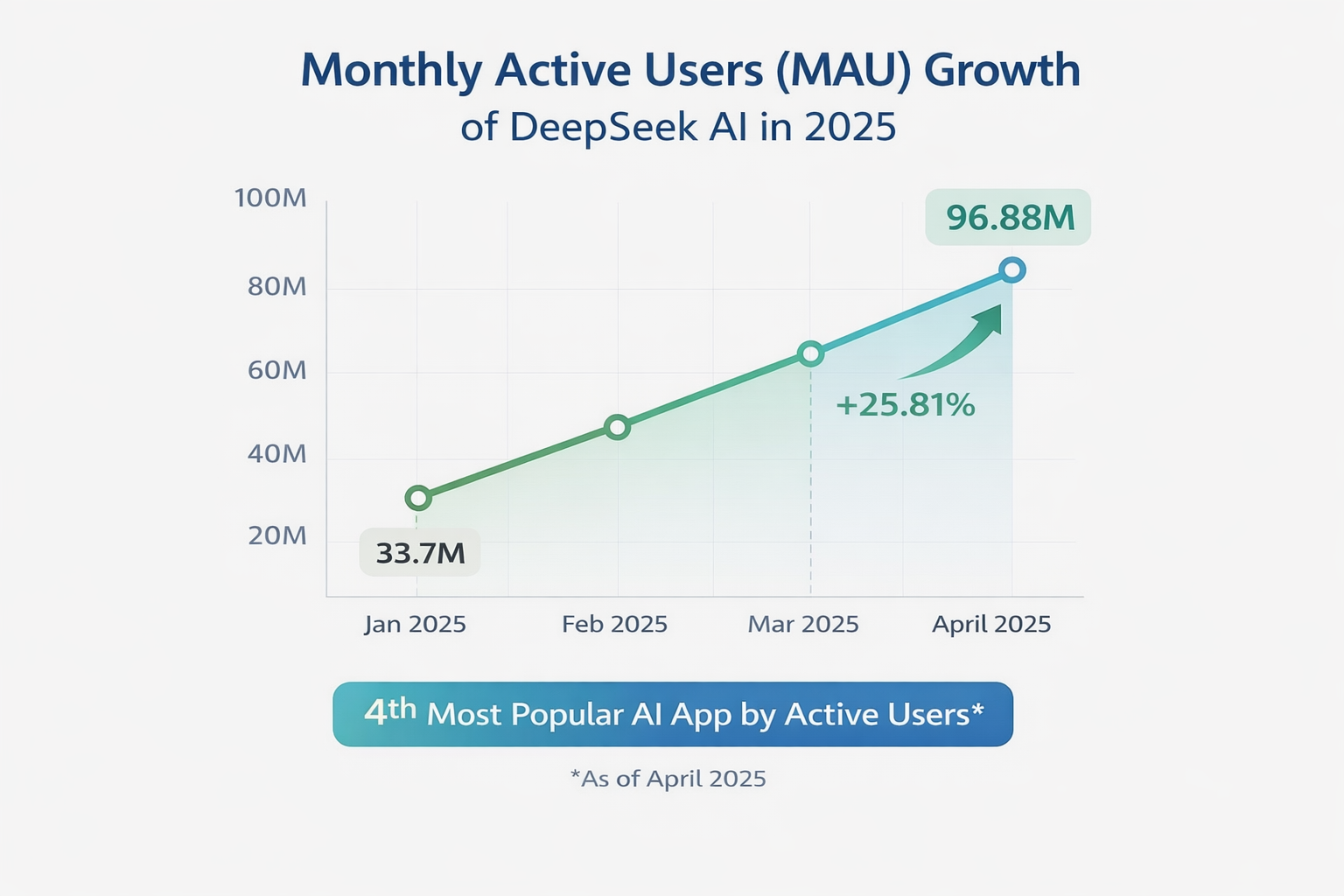
To place this in context:
- January 2025 MAU: 33.7 million
- April 2025 MAU: 96.88 million
- Month-over-month growth (March → April): +25.81%
These DeepSeek AI user growth figures make DeepSeek the fourth most popular AI app globally by active users.
Daily Active Users (DAU)
Daily engagement paints a similar picture. In January 2025, DeepSeek recorded:
- 22.15 million daily active users worldwide
This level of engagement places DeepSeek among the fastest-scaling consumer AI products ever documented.
Why MAU Figures Differ Across Sources
Some DeepSeek AI Statistics show variation across platforms. This does not indicate inaccurate reporting. Differences typically stem from:
- App-only versus web-inclusive measurement
- Distinct analytics tools
- Different reporting periods
Because DeepSeek is a private company, no unified public dashboard exists. This article reports every DeepSeek AI users figure with direct attribution, without blending datasets.
Geographic Adoption: Where DeepSeek AI Users Come From
DeepSeek’s growth is not evenly distributed. It is highly concentrated.
Top Countries by Monthly Active Users (January 2025)
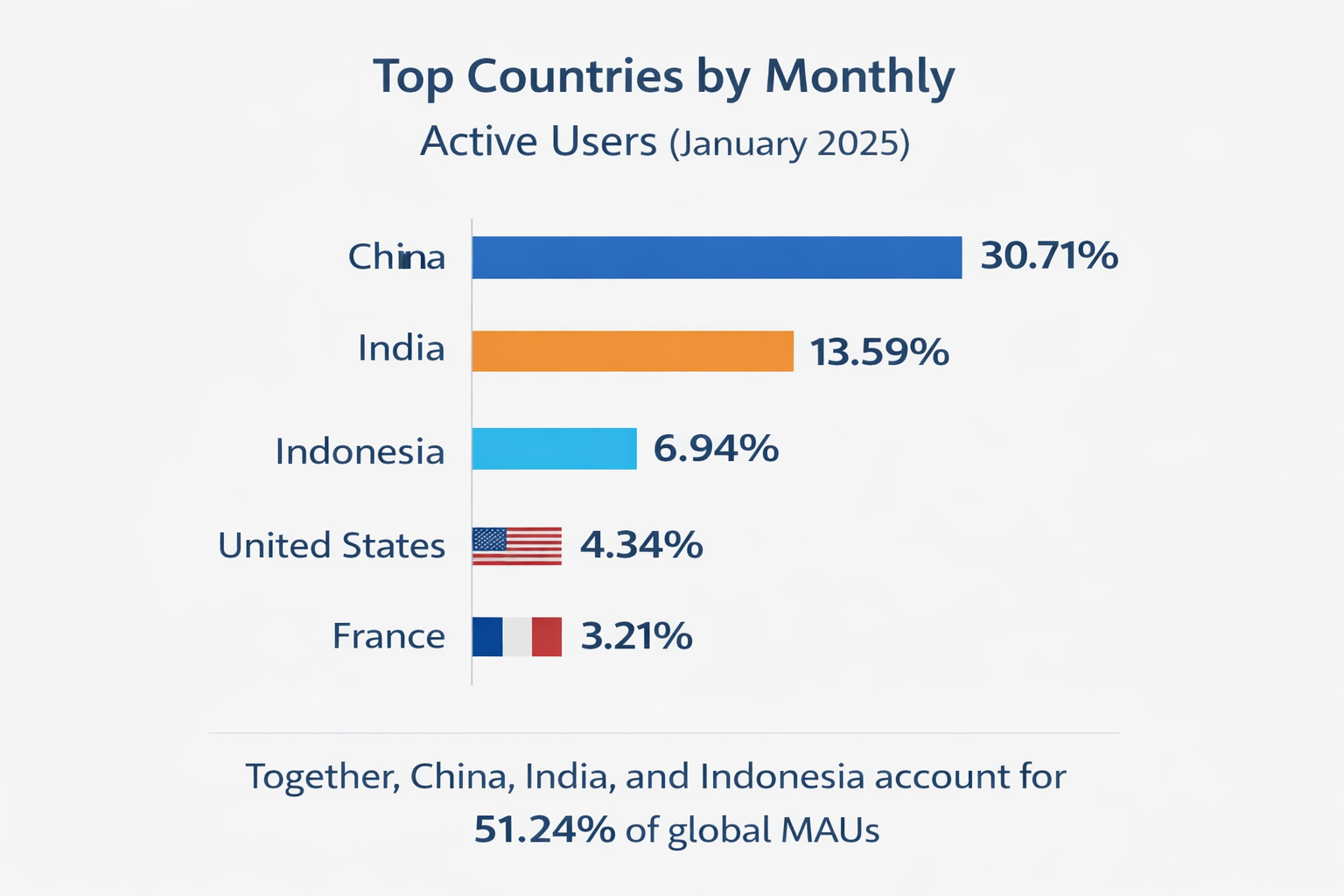
The geographic breakdown of DeepSeek AI users shows:
- China: 30.71%
- India: 13.59%
- Indonesia: 6.94%
- United States: 4.34%
- France: 3.21%
Together, China, India, and Indonesia account for 51.24% of global MAUs.
What This Geographic Split Indicates
This distribution helps explain why regulatory scrutiny emerged quickly after adoption accelerated.
- Asia drives DeepSeek’s scale
- Western markets adopt more cautiously
- Developer-dense regions respond fastest to cost efficiency
DeepSeek AI App Downloads (2025)
Downloads provide another lens into adoption speed.
Total App Downloads
As of May 22, 2025, DeepSeek reached:
- 57.2 million total downloads worldwide
- Google Play: 34.6 million
- App Store: 22.6 million
Monthly Download Breakdown (2025)
| Month | Downloads |
| January 2025 | 14.2 million |
| February 2025 | 19.6 million |
| March 2025 | 9.0 million |
| April 2025 | 9.0 million |
| May 2025* | 5.4 million |
Downloads by Country
Download distribution reinforces the same regional pattern:
- China: 34%
- India: 8%
- Russia: 7%
- United States: 6%
- Pakistan: 4%
- Brazil: 4%
- Indonesia: 4%
- France: 3%
- United Kingdom: 3%
DeepSeek User Demographics: Who Is Using the App?
DeepSeek’s audience skews young, which shapes product adoption.
Age Distribution by Platform
iOS users:
- 18–24: 38.7%
- 25–34: 22.1%
- 35–49: 15.3%
- 50–64: 23.3%
- 65+: 0.6%
Android users:
- 18–24: 44.9%
- 25–34: 13.2%
- 35–49: 14.9%
- 50–64: 26.1%
- 65+: 1%
Across both platforms, the user base leans male.
Why This Demographic Mix Matters
- Students adopt early
- Developers test aggressively
- Older users join once utility is proven
This mirrors earlier AI adoption cycles seen with generative platforms.
DeepSeek AI Performance: Benchmarks and Model Capability
DeepSeek AI Statistics are not compelling only because of user scale. They are equally compelling because of DeepSeek AI performance.
DeepSeek entered a highly competitive AI environment dominated by OpenAI and Google. Despite that, performance benchmarks show that DeepSeek achieved near-parity in several critical tasks.
Benchmark Performance vs OpenAI
According to benchmark data:
- DeepSeek-R1 outperformed OpenAI-o1-1217 in 2 out of 5 coding benchmarks (40%)
- OpenAI-o1-1217 won 3 out of 5 benchmarks (60%)
Detailed comparison:
| Benchmark | DeepSeek-R1 | OpenAI-o1-1217 | Winner |
| LiveCodeBench | 65.9% | 63.4% | DeepSeek |
| Codeforces Rating | 2029 | 2061 | OpenAI |
| Codeforces Percentile | 96.3% | 96.6% | OpenAI |
| SWE Verified | 49.2% | 48.9% | DeepSeek |
| Aider-Polyglot | 53.3% | 61.7% | OpenAI |
These DeepSeek AI performance results show that DeepSeek can compete directly with premium models.
Context Length and Token Capacity
DeepSeek supports long-context workloads.
- Context window: 128,000 tokens
- Maximum output per response: 8,000 tokens
This allows DeepSeek to process long documents, large codebases, and extended research workflows in a single interaction.
Training Scale and Cost Efficiency
This is where DeepSeek AI Statistics shifted industry expectations.
Training Cost Comparison
DeepSeek-V3 reportedly cost:
- $5.5 million to train
By comparison:
- OpenAI GPT-4 reportedly cost over $100 million
That makes DeepSeek roughly 1/18th the training cost of GPT-4.
Training Infrastructure
DeepSeek’s training process involved:
- 14.8 trillion tokens
- 2.788 million Nvidia H800 GPU hours
- Approximately 2,000 Nvidia H800 chips
Despite limited access to the newest GPUs, DeepSeek reached competitive performance levels.
Why Cost Efficiency Matters
Lower training costs result in:
- Lower inference pricing
- Faster iteration cycles
- Broader access for developers
These factors explain why DeepSeek AI business decisions triggered pricing reactions across the Chinese AI ecosystem.
DeepSeek AI Revenue: What We Know (and What We Don’t)
Revenue is the least transparent part of DeepSeek AI Statistics.
DeepSeek is a private company. It does not publicly disclose revenue.
However, pricing data provides strong monetization signals.
Token Pricing (Usage Cost)
DeepSeek offers some of the lowest usage costs in the AI market.
- Input token cost: $0.14 per million tokens
- Output token cost: $0.28 per million tokens
These figures position DeepSeek as one of the most cost-efficient high-performance AI models available.
Output Token Cost Comparison
| Model | Output Cost per Million Tokens |
| OpenAI GPT-4 | $30.00 |
| Claude-3.5-Sonnet | $30.00 |
| Google Gemini 1.5 Pro | $10.00 |
| OpenAI GPT-4 Mini | $3.00 |
| DeepSeek-V3 | $0.28 |
| DeepSeek-R1 | $0.28 |
These DeepSeek AI revenue signals show how aggressively the platform undercuts premium competitors.
What Revenue Likely Means for DeepSeek in 2025
Instead of focusing on subscriptions alone, DeepSeek AI revenue likely comes from:
- API usage
- Enterprise licensing
- Infrastructure and platform partnerships
At this stage, DeepSeek appears to prioritize adoption and ecosystem growth over short-term monetization.
Security Issues and Country-Level Restrictions
Rapid growth brought increased scrutiny.
Registration Restrictions
Due to reported cyberattacks, DeepSeek temporarily restricted new user registrations.
This slowed onboarding but did not reverse overall growth.
Countries and Institutions That Restricted DeepSeek
Reported restrictions include:
- Italy: Removed from app stores after a privacy investigation
- Taiwan & Australia: Banned within government agencies
- South Korea: Restricted across key ministries
- United States: Limited or blocked use by Congress, Navy, Pentagon, NASA, and Texas state agencies
These actions reflect regulatory caution rather than a collapse in DeepSeek AI users.
Future of DeepSeek AI: 2025 Outlook
DeepSeek AI Statistics suggest strong momentum. But growth is not guaranteed.
Growth Drivers
- Extremely low usage costs
- Rapid developer adoption
- Open-source credibility
- Competitive model performance
Key Risks
- Regulatory restrictions
- Security scrutiny
- Limited global compliance infrastructure
- Monetization uncertainty
What to Watch Going Forward
If you track only a few metrics, watch these:
- Monthly active users trend
- Enterprise adoption signals
- Pricing changes
- Expansion into multimodal AI
AI SEO Built for the Post-Google Era
AWISEE delivers AI SEO strategies optimized for LLM-based platforms like DeepSeek, ensuring your brand is discoverable where AI users ask questions and make decisions.