

Last updated:
Content Localization has become a central strategy for every brand expanding internationally. As global audiences grow more selective, they expect content that speaks directly to their cultural context. This shift makes brands rethink how they communicate beyond simple translation. Many companies now rebuild whole narratives to match local behavior, values, and expectations. This is why Content Localization is not only a linguistic process but also a psychological one.
A localized message can shape trust, engagement, and long-term loyalty across regions. When done correctly, it becomes a strategic advantage for global growth. Research consistently shows that users prefer interacting with content created for their culture. Local examples, visuals, and tone make audiences feel understood. This approach works especially well when brands enter competitive global markets. Local relevance also strengthens SEO performance. In this article, we explore how Content Localization works, why it matters, and how brands can apply it strategically in 2026.
Understanding Content Localization in 2026
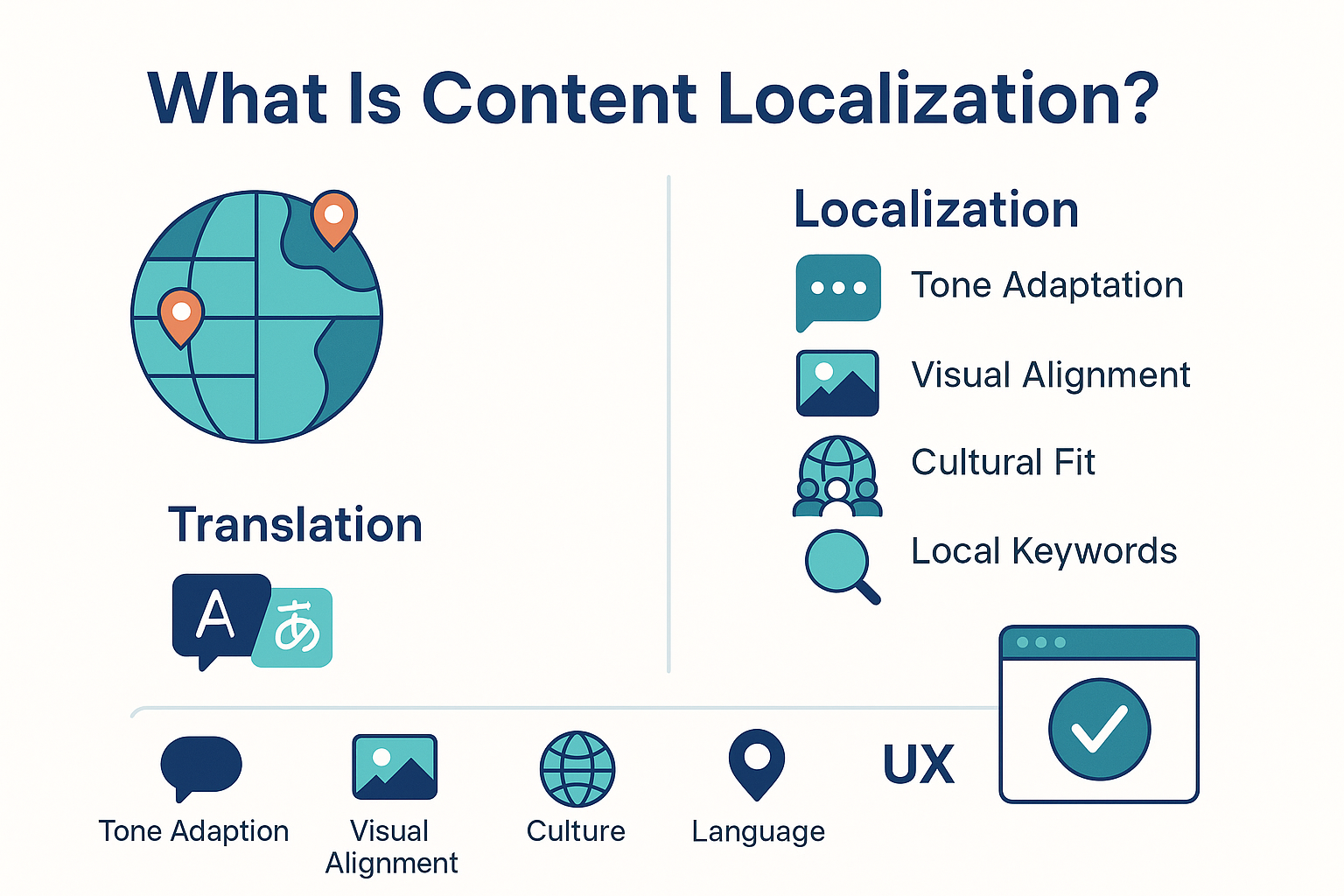
Content Localization means adjusting content so it fits the language, tone, cultural references, visuals, and expectations of a specific audience. Brands rewrite examples, update imagery, and adjust messaging so it sounds natural to users in each region. This is the foundation of any strong localization strategy.
Why Localization Matters for Global Growth
Obviously most consumers prefer buying from brands that communicate in their own language. This proves how essential Content Localization is for global growth. Users trust brands faster when the content reflects their identity, and this leads to higher engagement and improved conversions.
Boost Your Global Reach With AWISEE’s Localization Experts
Localize your brand the right way — work with AWISEE’s expert content localization team and make every market feel like home.
How Content Localization Drives Global User Engagement
Localized content improves engagement because people feel the content was made specifically for them. It also helps avoid confusion and cultural friction.
Key Reasons Why Engagement Increases:
- Users process localized information faster
- Content matches cultural habits
- Local references feel more relatable
- Trust grows naturally
When audiences see their culture reflected in the content, the emotional connection becomes stronger.
Preparing Your Brand for Content Localization: The Must-Do Pre-Work
Before starting any major localization strategies 2026, it is important to prepare your structure and workflow.
Conducting a Content Audit
A content audit helps identify which assets you already have and which ones require Content Localization. It also helps you mark high-priority items based on market potential, traffic, and user intent.
Identifying Target Regions
Different markets behave differently. You must understand each target audience’s motivations, cultural expectations, and content preferences before localizing content for global markets.
Mapping Content Formats
Regions vary in how they consume content. Some prefer long blogs, others prefer short videos, step-by-step guides, or infographics. Content Localization becomes more effective when you align formats with local behavior.
Core Framework: Step-by-Step Guide on How To Localize Your Content (2026)
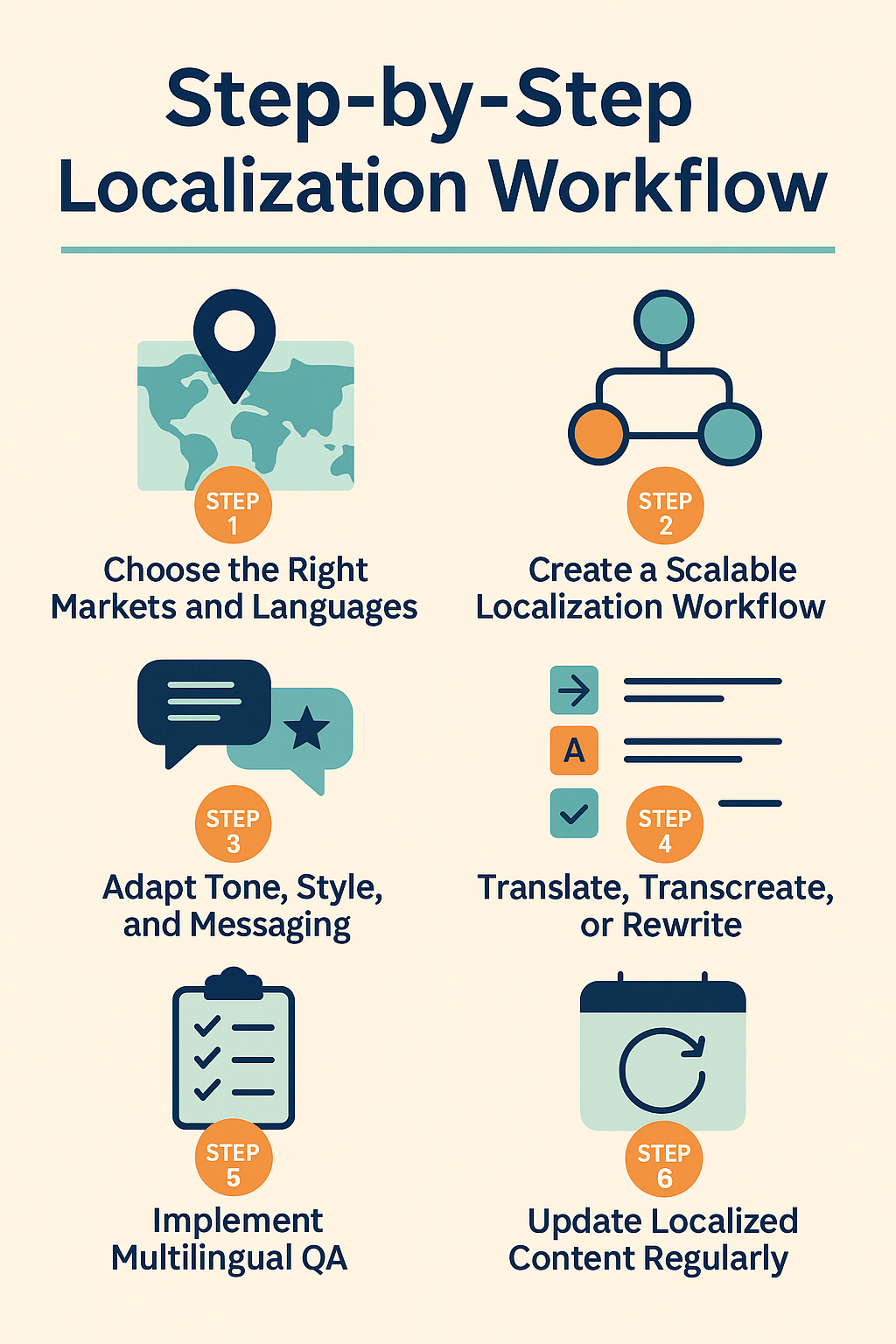
Localization succeeds when brands follow a structured process. Each step builds on the previous one.
Step 1: Choose the Right Markets and Languages
Start by identifying markets with the strongest demand. Consider search volume, cultural compatibility, and long-term opportunities.
Step 2: Create a Scalable Localization Workflow
A workflow ensures translators, reviewers, designers, and editors follow the same structure. This keeps Content Localization consistent across all regions.
Step 3: Adapt Tone, Style, and Messaging
Tone varies across cultures. A casual tone may work in one market, while others prefer formal or emotional communication. This is where cultural adaptation for content becomes essential.
Step 4: Translate, Transcreate, or Rewrite
You can choose between:
- Direct translation
- Transcreation (translation + creative adaptation)
- Complete rewriting for local context
The decision depends on content complexity and market goals.
Step 5: Implement Multilingual QA
Every localized version requires linguistic, functional, and stylistic reviews. This prevents mistranslations and protects brand trust.
Step 6: Update Localized Content Regularly
Markets evolve. Trends shift. Search behavior changes. Content Localization must remain continuous to stay relevant.
Localization Strategies 2026: Modern Methods Used by Global Teams

Modern teams now use hybrid workflows, combining AI tools with human experts. These localization strategies 2026 help brands work faster while keeping quality intact.
Effective Practices Include:
- Using terminology management systems
- Developing translation memory
- Automating review processes with AI
- Involving local reviewers for cultural accuracy
- Creating centralized guidelines for consistency
Phrase and Lokalise offer systems that simplify this process by aligning automation with human review.
Multilingual Content Marketing for Global Brands
Multilingual content marketing helps brands maintain their identity across borders while adapting messaging for each region.
This Involves:
- Local content calendars
- Voice and tone adjustments
- Using regional keywords
- Building stories around local culture
- Collaborating with local creators
Content Localization strengthens multilingual content marketing by making every piece of content feel natural to local audiences.
Cultural Adaptation for Content Across Regions
Cultural adaptation for content is one of the most important components of Content Localization. Even when the text is correct, cultural errors can damage trust.
Areas That Require Adaptation Include:
- Visuals and color meanings
- Cultural references and humor
- Holiday traditions
- Sensitive subjects
- Local beliefs and norms
A single cultural mismatch can disrupt the user experience, so brands invest heavily in cultural reviews.
Website Localization and International UX
Website localization plays a major role in Content Localization because it shapes how users interact with the website’s interface. It is more than translating text. It requires adapting user experience to match cultural expectations. This includes layout, navigation, forms, visuals, and reading patterns. Some regions prefer left-to-right reading, while others follow right-to-left structures. Currency formats, date formats, and number styles also differ across cultures. Website localization reduces friction, improves trust, and creates a smooth environment for users.
When a website feels local, people interact more comfortably. That comfort leads to better engagement and higher conversions. This is why companies invest heavily in UX testing for each market.
International SEO and Local Market Content Strategy
International SEO is a critical part of Content Localization. Every region has unique search behavior. Local keywords vary, competition changes, and search engines differ. Some markets use Google, others depend on Baidu, Naver, or Yandex. Local market content strategy becomes essential because brands must align their content with regional search intent.
Key Elements Of International SEO Include:
- Choosing correct hreflang tag structures
- Using country-specific URL formats
- Conducting local keyword research
- Updating metadata for each language
- Tracking regional SERPs separately
Localized content performs better because it mirrors regional language patterns. Search engines recognize this relevance, helping the brand compete more effectively.
Building a Global Content Production System
A strong global content production system keeps Content Localization consistent across dozens of markets. It ensures that every team follows the same process. This system usually includes:
- A central content repository accessible to global teams
- A glossary of terms for localization consistency
- Style guidelines for tone and brand voice
- A content update schedule for each region
- Collaborative workflows between writers, translators, and designers
This structure helps avoid confusion. It also speeds up the localization cycle. With global content production, brands can launch localized content quickly without sacrificing quality.
What Are The Best Practices For Localizing Content?
Zoe noted that 84% of businesses see revenue growth from localization. Content Localization becomes more successful when brands follow strong best practices. These ensure cultural accuracy, linguistic quality, and consistency.
Best practices include:
Using native linguists and in-market reviewers
People who live in the target market understand cultural nuance better. They detect expressions, tone shifts, and cultural markers that outsiders might overlook.
Prioritizing Cultural Meaning Over Literal Translation
Literal translation rarely works in real-world communication. Local meaning should always shape the final content.
Maintaining a Continuous Localization Cycle
Markets change. Trends evolve. Behaviors shift. Content Localization must stay flexible and active.
Tracking Performance and Improving Content
Monitoring bounce rates, scroll depth, and keyword performance helps identify where improvements are needed.
These best practices make Content Localization measurable and sustainable.
Quality Assurance & Governance for Localized Content
Quality assurance ensures that localized content maintains accuracy and cultural relevance. Governance structures help prevent inconsistencies. They also maintain brand identity across all regions.
Governance typically includes:
- Clear approval workflows
- Style guides for all markets
- Defined roles for review cycles
- Cultural guidelines for sensitive topics
- Functional QA tests on digital platforms
Strong governance protects brand consistency and ensures professional quality.
Common Mistakes to Avoid When Localizing Content
Brands often face challenges when they start Content Localization. These mistakes are common but preventable.
Common Mistakes Include:
- Overusing raw machine translation without human review
- Keeping metaphors or jokes that do not translate culturally
- Ignoring visual adaptation
- Using the same SEO keywords across all markets
- Failing to update localized content
Avoiding these mistakes helps maintain trust and improves the user experience.
Building a Future-Ready Localization Strategy for 2026 and Beyond
According to Centus, “The localization industry reached $71.7B in 2024 and is projected to grow to $75.7B in 2025.” Content Localization will continue evolving. AI-driven insights will improve adaptation. Predictive models will show which content to localize next. Brands will expand based on cultural similarity, not only language.
Future Trends Include:
- Predictive localization using user behavior data
- Automated linguistic checks
- Cultural similarity mapping
- Real-time content adaptation
These trends will reshape how companies approach global expansion.
Localize, Translate, and Rank Globally With AWISEE
Turn your content into culturally relevant, high-impact messaging with AWISEE’s localization, translation, and multilingual SEO services.