



Influencer marketing rules regulations are no longer optional reading for brands. They define how modern advertising works. Influencer marketing has fully crossed into regulated territory. It no longer sits on the edge of advertising. It is advertising. Brands now invest heavily in creators across Instagram, TikTok, YouTube, Twitch, and emerging platforms. According to Traackr, influencer marketing spend in the United States alone reached $7.14 billion in 2024.
Influencer marketing rules regulations are no longer background concerns. They sit at the center of brand strategy. Digital influence reaches millions instantly, and that reach carries responsibility. Regulators have rewritten influencer advertising rules to reflect modern media behavior. Paid content must be identified. AI-generated promotions must be disclosed. Youth audiences must be protected. Influencer marketing regulations 2026 formalize these expectations. This guide explains how they work and why they matter. Brands that understand these rules operate with confidence. Those that ignore them face growing risk.
Global Overview of Influencer Marketing Rules & Regulations
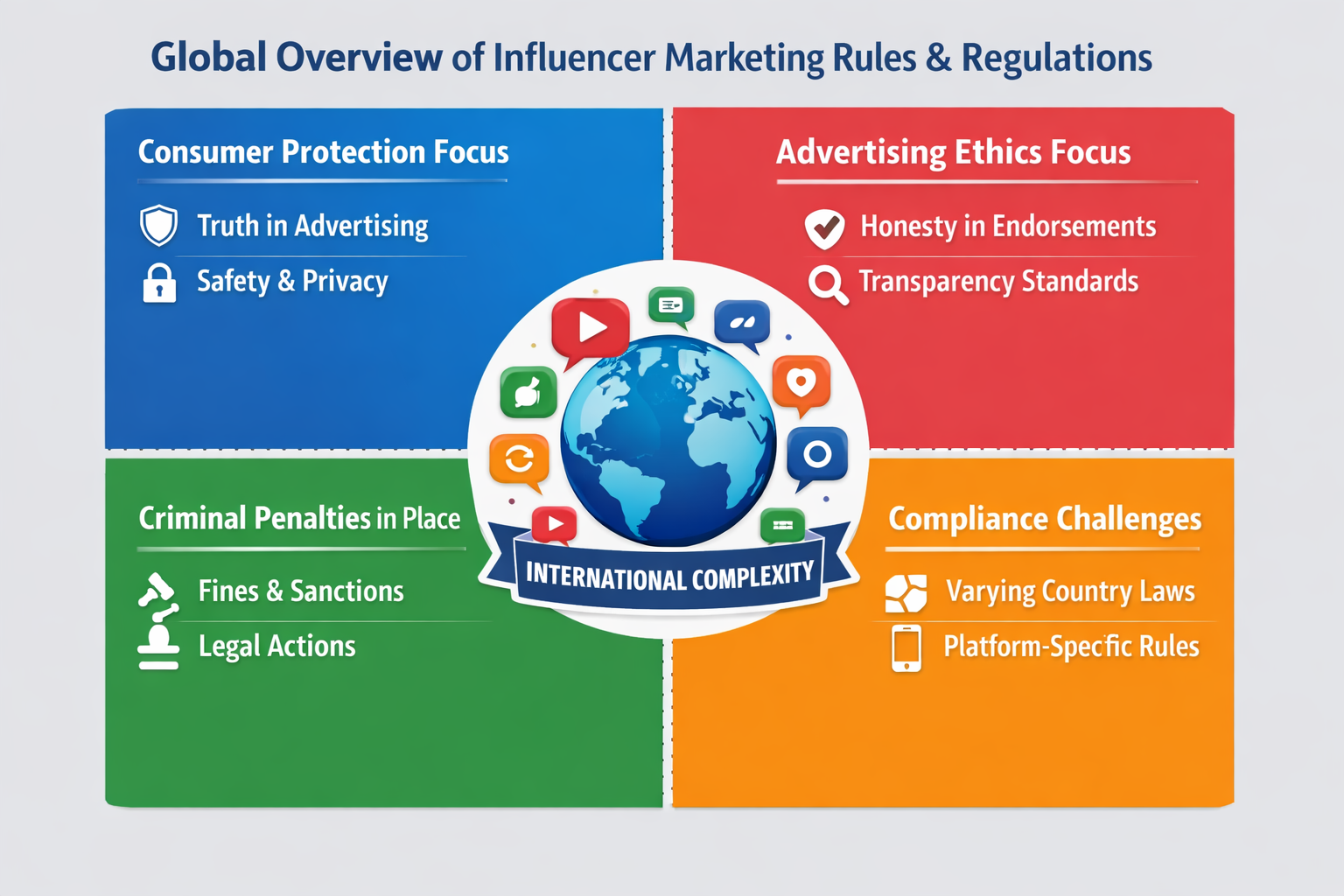
Influencer marketing rules regulations do not operate under one global authority. Each country applies its own framework.
- Some regions focus on consumer protection.
- Others focus on advertising ethics.
- Some now include criminal penalties.
This creates serious complexity for international brands.
A campaign compliant under US influencer marketing legal guidelines may violate UK influencer advertising rules. A disclosure accepted on Instagram may fail under TikTok or Stories standards. This fragmented landscape explains why influencer marketing compliance guidelines have become essential for brands, agencies, and creators operating across borders.
Navigate Influencer Regulations Across Markets
Running campaigns across borders introduces regulatory complexity. AWISEE helps brands manage influencer marketing rules regulations in the US, UK, and EU with structured compliance frameworks and ongoing oversight.
Influencer Marketing Rules Regulations in the United States (FTC Framework)
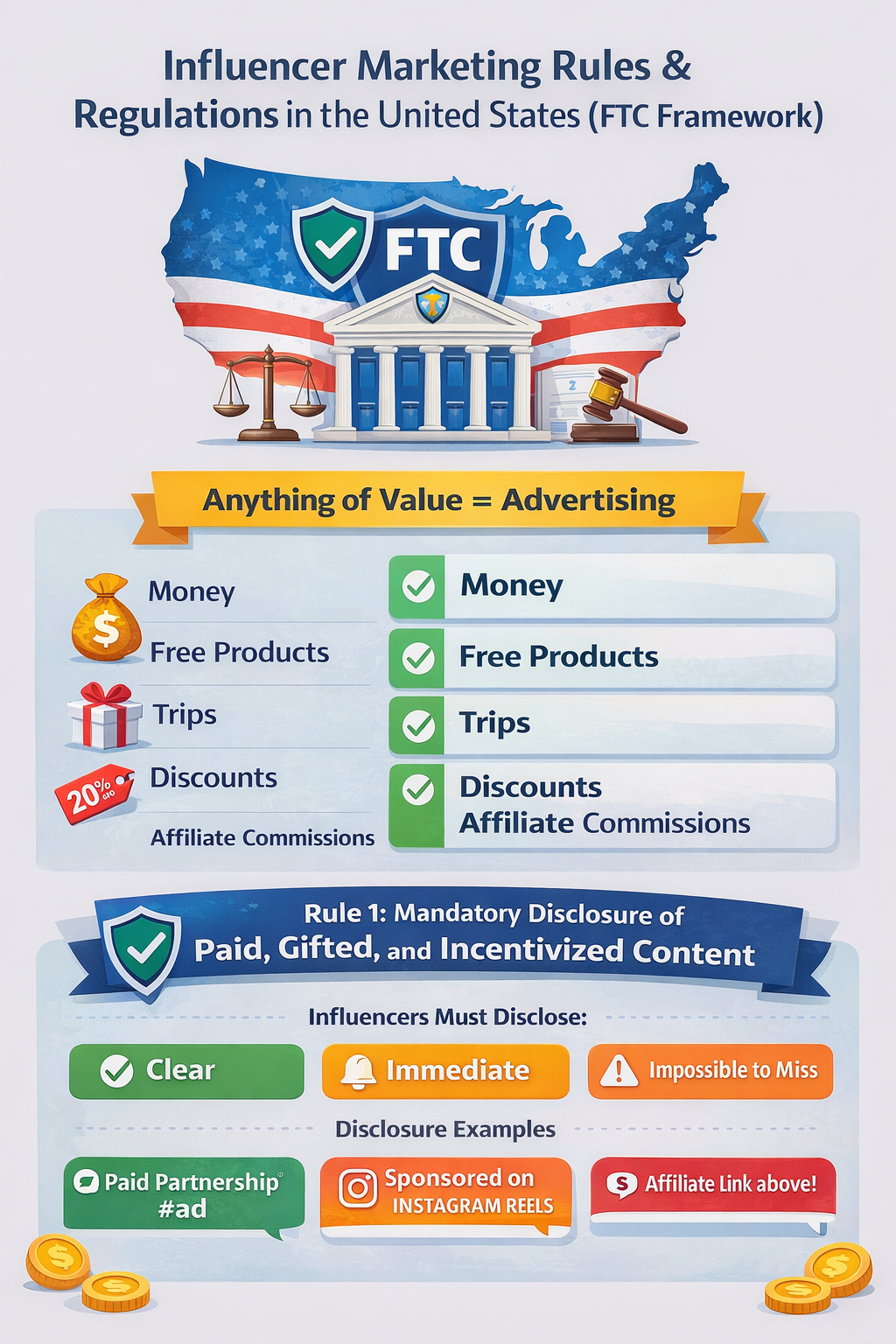
In the United States, influencer marketing rules regulations are enforced primarily by the Federal Trade Commission (FTC). The FTC treats influencer content as advertising whenever anything of value is exchanged.
As per cukeragency, that includes:
- Money
- Free products
- Trips
- Discounts
- Affiliate commissions
Mandatory Disclosure of Paid, Gifted, and Incentivized Content
This rule sits at the center of US influencer disclosure requirements.
If an influencer receives value and publicly mentions a brand, that relationship must be disclosed. The FTC does not distinguish between paid and gifted content when it comes to disclosure obligations.
Disclosure applies to:
- Paid sponsorships
- Gifted products
- Loaned items
- Press trips
- Discount codes
- Affiliate links
FTC guidance is simple. If a consumer might assume the influencer paid for something themselves, disclosure is required. This rule directly shapes influencer disclosure rules 2026 across US-based campaigns.
Influencer Disclosure Requirements Across Content Formats
Influencer disclosure requirements vary slightly by format, but the principle never changes. Disclosures must be:
- Clear
- Immediate
- Impossible to miss
Platform expectations include:
Image-based posts
- Disclosure appears on the image or at the beginning of the caption
Video content
- Disclosure is spoken
- Disclosure appears on-screen
- Disclosure appears in the description
Livestreams
- Disclosure is repeated periodically
The FTC explicitly warns against hiding disclosures behind “more” buttons or long captions. Doing so violates influencer promotion rules.
AI, Virtual Influencers, and Synthetic Content Disclosure
One of the most important updates within influencer marketing regulations 2026 involves AI-generated content. Virtual influencers are no longer exempt.
If a brand uses:
- Virtual influencers
- AI avatars
- Synthetic voices
- AI-generated visuals
Both sponsorship and AI involvement must be disclosed.
The FTC’s position is direct. Audiences have the right to know when content is paid and when it is artificially generated. This rule exists to preserve trust as deepfakes and synthetic media become harder to detect.
Influencer Advertising Rules for Brands and Agencies (Shared Liability)
For years, brands attempted to shift responsibility entirely onto creators. That approach no longer works.
Brands Are Legally Responsible for Influencer Compliance
Influencer advertising rules now assign shared liability. Brands, agencies, and influencers are all responsible for compliance. Brands must demonstrate active oversight.
That includes:
- Educating influencers on influencer disclosure rules 2026
- Reviewing content before publication
- Monitoring posts after they go live
- Acting quickly if disclosures are missing or unclear
If violations occur, regulators examine what the brand did to prevent them. Silence is no longer acceptable.
Influencer Marketing Regulations 2026 in the United Kingdom (ASA & CMA)
The UK enforces influencer marketing rules regulations through two main bodies:
- Advertising Standards Authority (ASA)
- Competition and Markets Authority (CMA)
Their primary concern is transparency.
An ASA analysis found that nearly two-thirds of promotional Instagram Stories were not clearly labeled as ads. This finding triggered stricter enforcement and clearer influencer marketing compliance guidelines.
Influencer Disclosure Rules 2026 Under ASA & CMA
Disclosure language matters greatly in the UK.
Accepted labels include:
- Ad
- Advert
- Advertisement
Labels considered unclear include:
- Gifted
- Sponsored
- Affiliate
- PR Trip
- In collaboration with
If consumers cannot instantly identify content as advertising, it fails UK social media influencer regulations.
Visibility and Placement Standards for Ad Labels
UK influencer advertising rules focus heavily on placement.
Disclosure must:
- Appear at the beginning of captions
- Be clearly visible on Stories
- Never rely on bios or profile descriptions
Even resharing an ad requires disclosure, regardless of additional payment. This closes loopholes creators previously used to soften advertising signals.
Sector-Specific Social Media Influencer Regulations
Influencer marketing rules regulations do not apply equally across all industries. Some sectors carry higher consumer risk. Because of that, regulators apply stricter influencer promotion rules to certain verticals. Finance and gambling receive the highest level of scrutiny. These social media influencer regulations exist to limit harm, especially to younger audiences.
Restrictions on Gambling and Financial Services Influencer Promotions
In the UK, gambling companies face strict influencer marketing legal guidelines.
They are prohibited from working with influencers who:
- Strongly appeal to audiences under 18
- Are sports figures popular with minors
- Appear in reality TV shows followed heavily by young viewers
The objective is direct. Reduce exposure of high-risk products to underage users.
Financial services face even tighter oversight.
The UK Financial Conduct Authority (FCA) has warned that influencers promoting regulated financial products without approval may be committing a criminal offense. This applies to:
- Investment platforms
- Crypto-related financial promotions
- High-risk trading products
These influencer marketing regulations 2026 place responsibility on both the influencer and the brand.
French Influencer Marketing Legal Guidelines (Influencer Act)
France currently enforces one of the most comprehensive influencer marketing rules regulations frameworks in the world. In June 2023, France introduced Act no. 2023-451, commonly referred to as the Influencer Act. This legislation reshaped influencer marketing compliance guidelines across Europe.
Mandatory Labels, Content Restrictions, and AI Disclosure
French law goes beyond disclosure. It also controls what influencers can promote.
Prohibited categories include:
- Cosmetic surgery and procedures
- Alternative therapeutic practices
- Nicotine products
- Certain financial and blockchain-based services
When promotion is allowed, labeling is mandatory.
Required disclosures include:
- “Advertisement” or “Commercial collaboration”
- “Retouched image” for edited visuals
- “Virtual image” for AI-generated content
These influencer disclosure requirements must be clear, legible, and instantly identifiable.
Contractual and Dropshipping Transparency Obligations
France also regulates the commercial structure behind influencer campaigns. A written contract is mandatory. That contract must clearly state:
- Identity of both parties
- Tax domiciliation
- Scope of influencer services
- Compensation or benefits
- Intellectual property terms
For dropshipping promotions, influencers must disclose:
- Supplier identity
- Whether fulfillment is handled by a third party
These influencer marketing legal guidelines exist to prevent deceptive commercial practices.
Influencer Marketing Compliance Guidelines for Youth Audiences
Children are treated differently under advertising law. And intentionally so.
Special Protections for Children and Teen Audiences
The FTC applies stricter influencer disclosure requirements to content aimed at younger viewers.
Subtle product placements are discouraged.
Unboxing-style promotions are closely monitored.
Recommended practices include:
- Verbal disclosures
- On-screen labels that remain visible
- Simple, age-appropriate language
The message is consistent. Children should never have to guess whether content is advertising.
Affiliate Links, Reviews, and Testimonials Under Influencer Promotion Rules
Affiliate marketing remains allowed under influencer marketing rules regulations. However, it is tightly regulated.
Honest Reviews and Commission Disclosure
Influencers must clearly disclose affiliate relationships.
Acceptable examples include:
- “I may earn a commission from this link”
- “This post contains affiliate links”
What influencers cannot do:
- Promote products they have not personally used
- Make unverified performance claims
- Hide negative experiences while promoting positives
Manipulating reviews or suppressing criticism may violate FTC endorsement rules.
What Happens When Influencer Marketing Rules Are Broken
Influencer marketing rules regulations carry consequences.
And enforcement is active.
Regulatory Complaints, Investigations, and Penalties
In the UK, complaints can be submitted to the ASA.
The process typically includes:
- Complaint assessment
- Response from the creator and brand
- Regulatory ruling
If violations persist:
- Content may be removed
- Creators may be publicly named
- Platforms may restrict or remove accounts
According to Disruptmarketing, In France, penalties may include financial fines and, in severe cases, criminal consequences.
How Brands Can Operationalize Influencer Marketing Rules & Regulations
According to a report published in AWISEE, “Influencer marketing in Europe is projected to exceed €20 billion by 2025, positioning itself as one of the fastest-growing digital marketing channels.” Compliance does not happen automatically. It must be designed into systems.
Building Compliance into Contracts and Influencer Briefs
Brands should clearly include:
- Country-specific disclosure requirements
- Platform-specific labeling rules
- Content approval processes
Influencer briefs should outline:
- Required disclosure language
- Placement standards
- Consequences for non-compliance
This reduces risk for both parties.
Governance Systems for Ongoing Influencer Compliance
Large-scale influencer programs require structure. Effective systems include:
- Centralized influencer policies
- Ongoing post-publication monitoring
- Fast correction workflows
- Documentation for audits
These influencer marketing compliance guidelines protect both brand reputation and creator credibility.
Build Influencer Campaigns That Stand Up to Scrutiny
Brands are now legally responsible for influencer compliance. AWISEE delivers influencer marketing services that include disclosure guidance, content review, and post-launch monitoring to reduce regulatory exposure.